
Quick answer: Worf is a Klingon officer in Starfleet in the science fiction series Star Trek. Played by Michael Dorn, he first appeared in Star Trek: The Next Generation and became one of the franchise’s best-loved characters. The “Worf effect” is also a well-known storytelling trope.
Featured image: Photo by Aperture Vintage on Unsplash
If you have ever scrolled past a meme with a stern-looking character with a ridged forehead, there is a good chance it was Worf. He is one of the most recognizable characters in Star Trek, and fans use his name for jokes, tropes and even a whole storytelling idea. This guide explains who Worf is, where he appears and why people love him.
In this guide
Who is Worf?
Worf is a Klingon, a proud warrior species in the Star Trek universe. He is also an officer in Starfleet, the human-led exploration and defense organization. Actor Michael Dorn plays him, and the role has lasted over three decades, an impressive run for one character.
Worf first appeared in Star Trek: The Next Generation (1987 to 1994) as the security chief on the starship Enterprise-D.

Worf’s story in brief
- Early life: After a Romulan attack on the Klingon outpost Khitomer, Worf was found as a young child and raised by human foster parents.
- Starfleet career: He grew up and joined Starfleet, becoming the first Klingon in the service.
- The Next Generation: He served on the Enterprise as security chief and later in other roles.
- Deep Space Nine: Worf joined the cast in later seasons and became a main character there.
- Films and Picard: He appears in several films and in Star Trek: Picard.
His mix of Klingon pride and human upbringing makes him a character caught between two worlds.
Worf’s family
| Person | Relationship | Notes |
|---|---|---|
| Mogh | Father | A Klingon warrior whose name Worf often carries as “son of Mogh” |
| The Rozhenkos | Foster parents | Human family who raised him |
| Alexander | Son | Raised partly by humans and Klingons |
| Jadzia Dax | Wife | A Trill officer on Deep Space Nine |
Worf’s family tells you a lot about him. He cares deeply about duty, but he also learns to be a father and a husband.
The Klingon code of honor
Worf lives by the Klingon sense of honor, which includes courage, loyalty and truthfulness in battle. He often reminds others about Klingon traditions, even when they seem strange to his human friends. This code gives him strong moral lines, and many fans enjoy how he applies them to tricky situations.
The Worf effect
The Worf effect is a famous trope, a repeated storytelling pattern. In it, a strong and trusted character is defeated by a new enemy, so the audience can see how dangerous that enemy is. The name comes from the way Worf was often shown losing fights to new threats in The Next Generation, even though he was one of the toughest members of the crew.
- A mighty hero loses to a new monster in the first scene.
- A top fighter is knocked out right away.
- The audience learns the new enemy is a real threat.
Today the term is used well beyond Star Trek, in discussions of movies, games and television.
Why fans love Worf
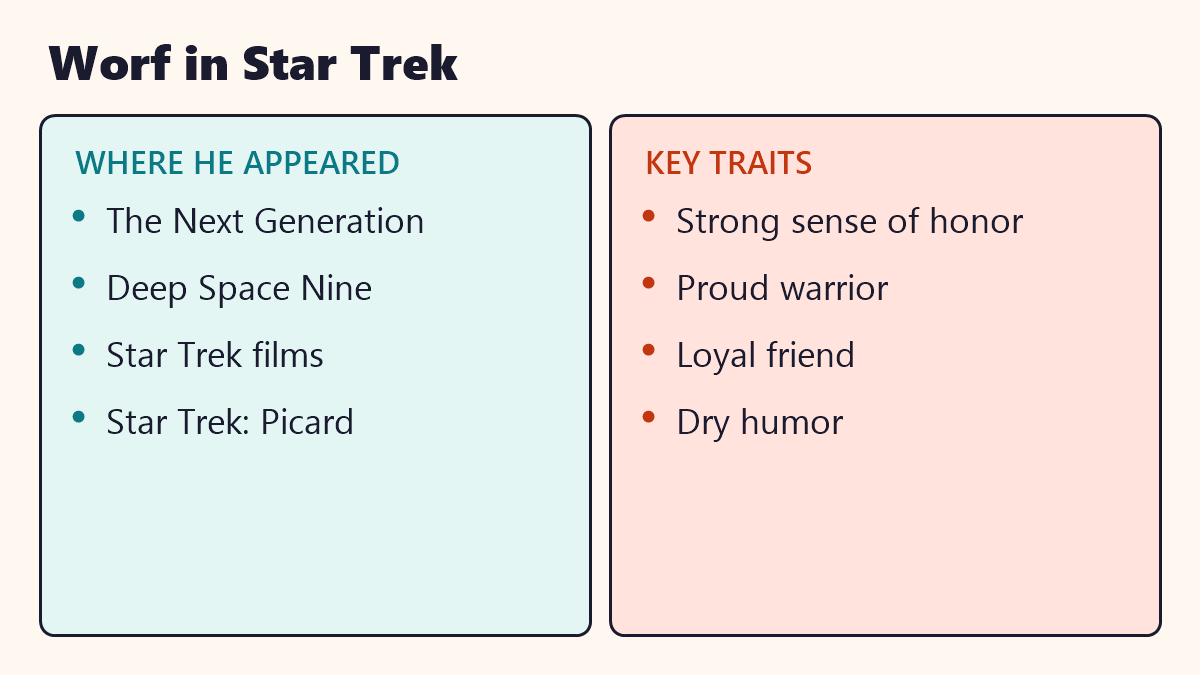
- His humor. His dry, serious jokes are fan favorites.
- His loyalty. He stays true to his friends even in danger.
- His honesty. He says what he thinks.
- His growth. Over the years he learns about family, peace and compromise.
- His look. The forehead ridges and sash are instantly recognizable.
Worf in popular culture
Worf’s calm voice and stern face became popular with fans online. People make memes of him from scenes that capture awkward or serious moments. Michael Dorn has been a regular guest at fan conventions and has joked about the character’s fame. The appeal is simple: Worf is a serious character in a world that loves a good laugh.
Common mistakes
- Thinking Worf is human. He is a Klingon raised by humans.
- Mixing up Klingons and Romulans. They are different species.
- Misspelling the name. It is W-O-R-F, not “Warf.”
- Forgetting the long career. Worf appeared in multiple series, not only one.
Key takeaways
- Worf is a Klingon officer in Starfleet in Star Trek.
- Michael Dorn plays him across several series and films.
- He was raised by human foster parents and lives by Klingon honor.
- The “Worf effect” shows a strong character losing to build a new threat.
- He remains one of Star Trek’s most loved characters.
Worf’s rank over the years
Worf’s position changed across the different series he appeared in, reflecting the character’s long arc rather than a single fixed role. He moved from security officer, to strategic operations officer, to eventually serving in ambassadorial and command-adjacent roles in later appearances, one of the longer character progressions in the franchise.
Why the Worf effect resonates beyond Star Trek fans
The trope caught on partly because it names something viewers across many genres had already noticed without a word for it. Once named, people began spotting “Worf effect” moments in action movies, video games, and other franchises, which helped the term spread well past its original Star Trek context.
Frequently asked questions
Who is Worf in Star Trek?
Worf is a Klingon who serves in Starfleet. He is a security officer and later a diplomat and captain’s ally in several Star Trek series and films.
Who plays Worf?
Actor Michael Dorn plays Worf in The Next Generation, Deep Space Nine, several films and Star Trek: Picard.
What is the Worf effect?
It is a story trick where a strong, trusted character is beaten to show that a new threat is dangerous.
Is Worf human?
No. Worf is a Klingon, a proud warrior species in Star Trek. He was raised by human foster parents.
Does the name Worf have a meaning?
No official meaning is given. It is the name of a Klingon character, and fans simply know it as his name.