
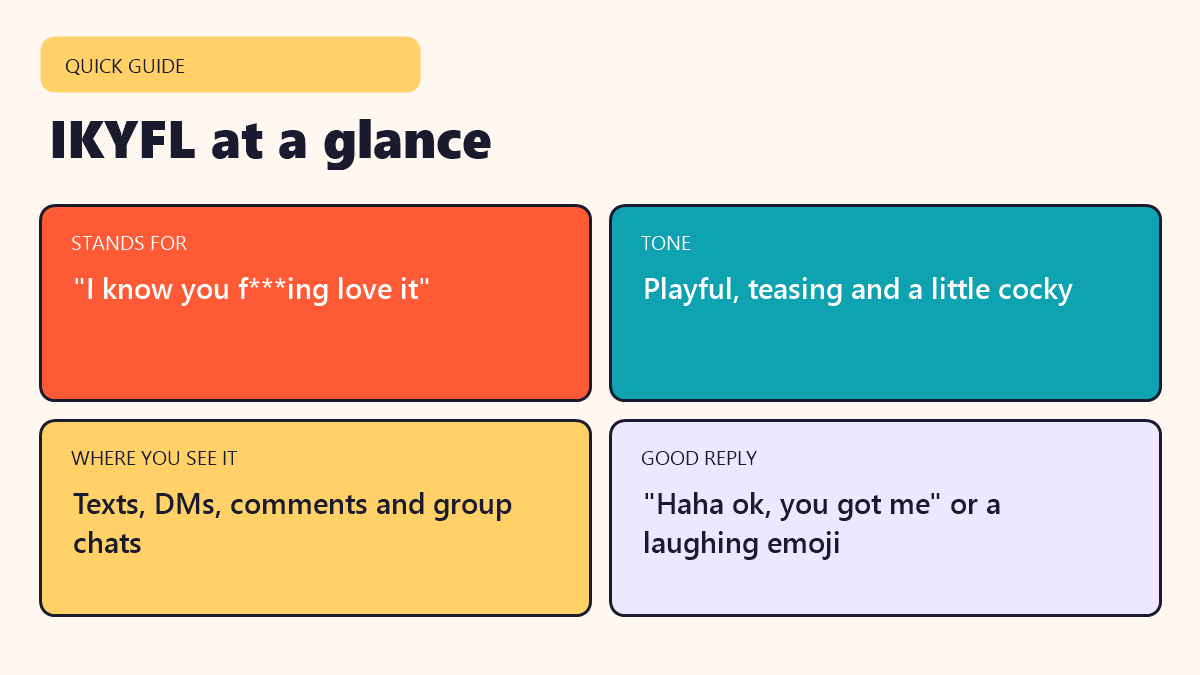
Quick answer: IKYFL stands for “I know you f***ing love it.” People send it as a playful, slightly cocky tease when they think you secretly enjoyed something, such as a joke, a compliment or a bit of friendly drama. It is casual, strong-language slang meant for friends.
Featured image: Photo by Vitaly Gariev on Unsplash
You open a chat, a friend has sent a reply, and it is just five letters: ikyfl. No explanation, maybe a smirking emoji. If you stared at it for a moment, you are not alone. This guide explains exactly what IKYFL means, where you will see it, how to answer it and when it is better to keep it to yourself.
What does IKYFL mean?
IKYFL is a text abbreviation for “I know you f***ing love it.” Some people also write it as “I know you love it,” and the meaning stays the same. The message is simple: you can act annoyed, but I can tell you are enjoying this.
The tone is what makes the phrase work. IKYFL is not usually an insult. It is a teasing line, the kind of thing you say with a grin to someone who just got what they wanted, enjoyed a joke they pretended to hate, or secretly liked the attention.
Breaking down the letters
Abbreviations are easier to remember when you see each letter. Here is IKYFL piece by piece:
- I = I
- K = know
- Y = you
- F = the strong swear word that adds emphasis
- L = love it
Read together, the pattern is a confident statement about the other person’s feelings. That is why it feels like a friendly “gotcha” and not a question.
Where does IKYFL come from?
There is no official record of who first typed IKYFL, and it is hard to date slang that spreads through private chats. What we can say is that the phrase behind it, “I know you love it,” has been a cheeky catchphrase in English for a long time. Pop culture helped make it famous, and text messaging did what it always does: it shrank the phrase into an abbreviation.
The “f***ing” in the middle adds emphasis. Many young people use mild swearing as a way to sound casual and confident, so the abbreviation stuck. Today you will mostly spot it on messaging apps, Snapchat, Instagram comments and in short-video replies.
How people use IKYFL in real conversations
The best way to understand slang is to see it in action. These examples show the most common situations.
Teasing a friend after a win
Friend: Fine, your pizza pick was actually good.
You: ikyfl 😏
Answering a compliment with a smirk
Friend: That outfit is annoyingly good.
You: ikyfl
Replying to a playful complaint
Friend: Stop sending me memes every morning.
You: lol ikyfl
Flirty banter
Between people who like each other, IKYFL can be a light flirt. It says “I can see you are into this” without spelling it out. Because it can read as bold, it works best when you already know the other person is comfortable with that kind of joking.
What tone does IKYFL carry?
Think confident, cheeky and relaxed. It sits somewhere between “told you so” and “admit it.” Three things change how it lands:
- The relationship. With a close friend it sounds fun. With someone you barely know it can sound pushy.
- The emoji. A laughing or smirking emoji softens it. Sending it alone can feel flatter or more smug.
- The topic. Teasing about food, music or memes is safe. Teasing about someone’s feelings or worries is not.
How to reply when someone sends IKYFL
You have a few easy options, depending on whether you want to play along or push back:
- Play along: “Haha okay, you got me.”
- Tease back: “Don’t get too proud of yourself.”
- Keep it short: a laughing emoji or “lol fair.”
- Deny it with humour: “I would never.” (You both know the truth.)
- Set a boundary kindly: “Ha, not this time.” if you honestly did not enjoy it.
You do not have to agree. If the joke does not match how you feel, a calm reply is fine.
When it is fine to use IKYFL, and when to skip it
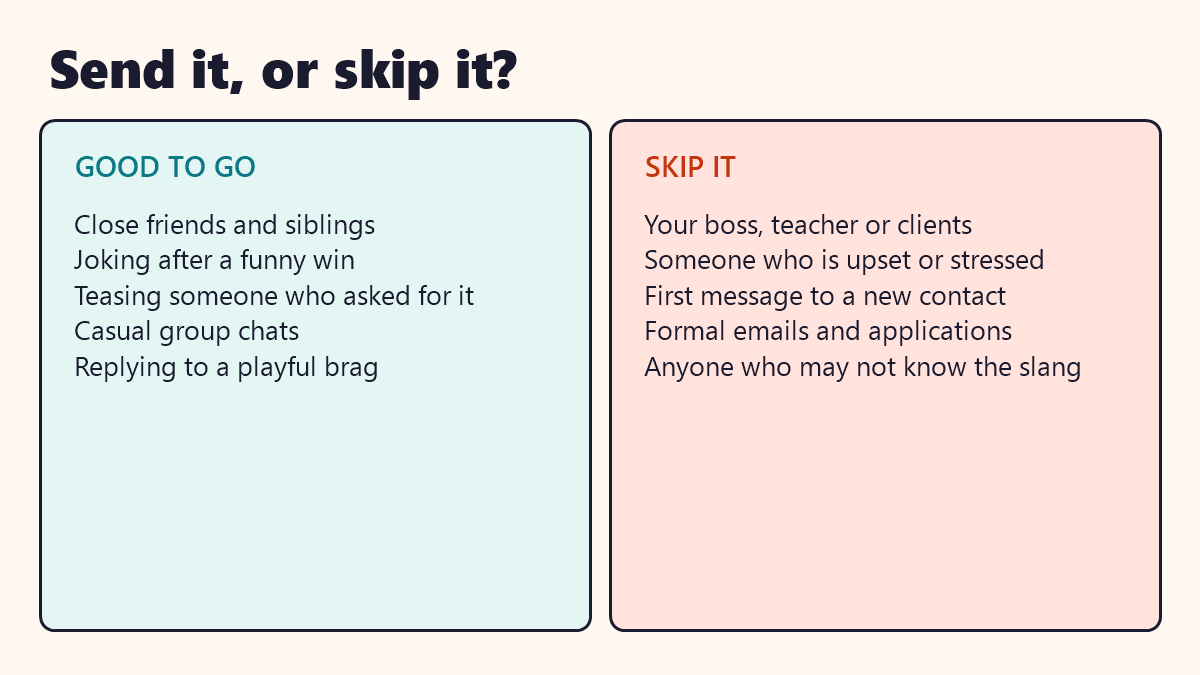
Context decides everything. The graphic below is a quick checklist you can save.
Good places to use it
- Chats with close friends and siblings
- Group chats where everyone jokes around
- Right after a playful brag or a funny win
- Replying to someone who clearly invited the tease
Better to skip it
- Messages to a boss, teacher or client
- Anyone who is stressed, sad or angry
- A first message to someone new
- Professional emails, applications or school work
- People who may not know the slang and could misread it
A simple rule: if you would feel uncomfortable reading the full phrase out loud to the person, do not send the abbreviation.
IKYFL compared with similar slang
Several short forms sit in the same neighbourhood. They are easy to mix up, so here is how they differ.
- IKR means “I know, right?” and is used to agree, not to tease.
- ICL means “I can not lie” and introduces an honest opinion.
- TBH means “to be honest” and also signals a frank comment.
- Lowkey means “quietly” or “a little” and softens a feeling.
- Cap / no cap means lying or telling the truth.
If you want a wider view of everyday abbreviations, browse our text slang hub.
IKYFL on different apps
The platform changes the feel of the message, even when the letters are the same.
Text messages and iMessage
In a one-to-one chat the phrase feels personal. Both people usually know the history behind the joke, so a short reply lands well.
Snapchat and Instagram DMs
Fast, informal and full of emoji. IKYFL often travels with a photo or a reaction, such as a selfie after a good haircut, and the emoji does half the talking.
Comments and group chats
In public spaces, more people can see it, so the tease can read as bolder. Use it only where the other person is comfortable being joked with in front of others.
TikTok and short video replies
Creators and followers use it to joke about trends, duets and obvious favourites. It signals shared humour with an audience, not a private message.
Cleaner ways to say the same thing
Maybe you like the idea but not the swear word, or you are texting someone who might not. These alternatives keep the playful mood:
- “I know you love it.”
- “Admit it, you liked that.”
- “Don’t pretend you didn’t enjoy that.”
- “You totally loved that.”
- “Told you you’d like it.”
Any of these will work in an email to a colleague you are friendly with, or in a message a parent might read over your shoulder.
Why friendly teasing feels good between friends
Light teasing is one way people show closeness. When a friend says “I know you love it,” they are signalling that they know your taste, your habits and your humour. It tells you that you are seen. That is the real reason a short abbreviation can feel warm instead of rude.
It only works when both sides feel safe. A tease should never target something the other person is self-conscious about. If you notice the other person pulling back, stop and move on to something else. Good banter always leaves room for the other person to laugh too.
Common mistakes with IKYFL
- Using it to put someone down. The phrase teases, it does not mock. If it sounds like an insult, rewrite it.
- Sending it in formal settings. The strong language is a bad fit for work or school.
- Overusing it. A tease repeated every message gets tiring.
- Missing the mood. If the other person is upset, humour of this kind can feel dismissive.
Is IKYFL rude or offensive?
It contains a swear word, so it is not appropriate for every audience. Among friends it is usually seen as playful, not hostile. Even so, you should think about who might read it. If a parent, teacher or manager may see your message, choose the clean version, “I know you love it.”
Key takeaways
- IKYFL means “I know you f***ing love it.”
- It is a playful, confident tease used mostly between friends.
- Tone, emoji and relationship decide how it lands.
- Skip it in formal or sensitive situations.
- When unsure, use the plain phrase “I know you love it.”
Frequently asked questions
What does IKYFL stand for?
IKYFL stands for “I know you f***ing love it.” Some people also use it as shorthand for “I know you love it.”
Is IKYFL a flirty text?
It can be, depending on who sends it and the tone. Between friends it is usually just playful teasing, while between people who like each other it can read as light flirting.
How do I reply to IKYFL?
You can play along with “Haha, you got me,” tease back, send a laughing emoji or politely say it was not your thing. Match the mood of the conversation.
Is IKYFL appropriate for work?
No. The abbreviation contains strong language and is meant for casual chats, so avoid it with managers, clients and teachers.
Where did IKYFL come from?
No single origin is recorded. It grew out of the catchphrase “I know you love it” and became an abbreviation through texting and social media.