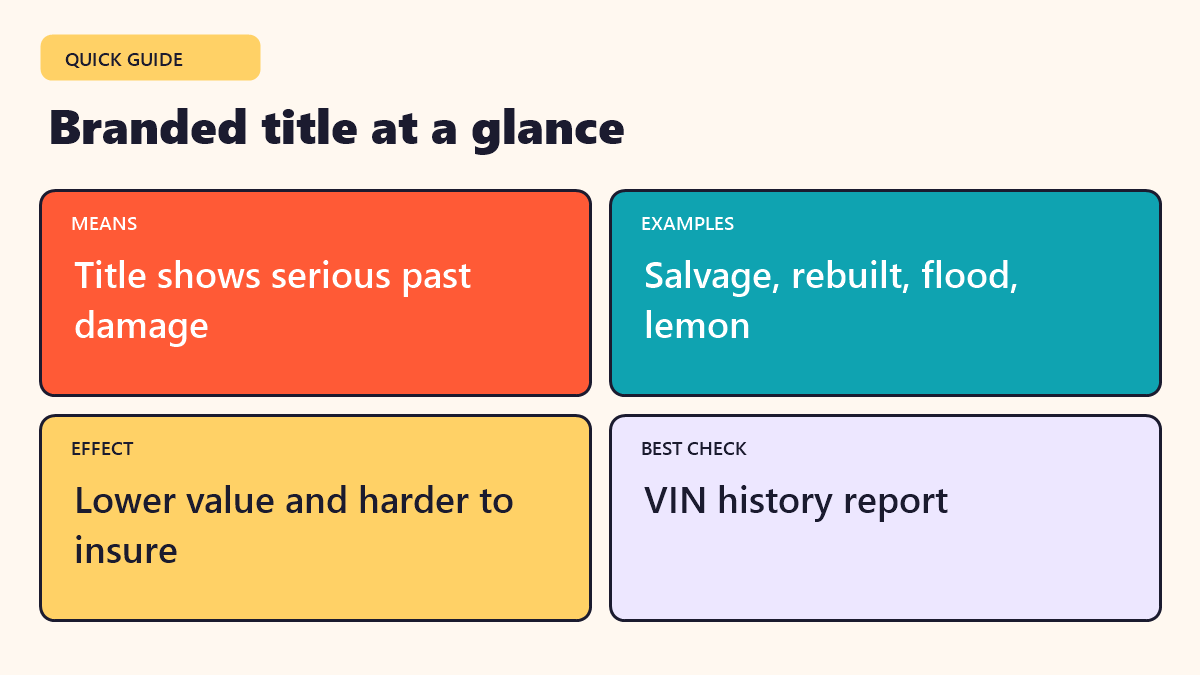
Quick answer: A branded title is a car title with a permanent note about the vehicle’s past, such as salvage, rebuilt, flood damage or lemon law buyback. It warns future buyers that the car had a serious problem, and it usually lowers the car’s value.
Featured image: Photo by Obi on Unsplash
You find a used car at a very good price. Then you read in the listing: “branded title.” What does it mean, and should you walk away? This guide explains what a branded title is, the main types, the risks and how to protect yourself before you buy.
In this guide
What is a branded title?
A title is the legal document that shows who owns a vehicle. A brand is a note added to that title when the car has a serious event in its history. Think of it as a permanent warning label that follows the car from owner to owner.
In the United States, the rules and the exact names for brands differ by state, and other countries have their own systems. The idea is the same: the record tells future buyers that something important happened.
Common types of title brands
| Brand | What it usually means | Notes |
|---|---|---|
| Salvage | An insurer declared the car a total loss after damage or theft | Often cannot be driven legally until repaired and inspected |
| Rebuilt or reconstructed | A salvage car was repaired and passed an inspection | Can be driven again, but value stays lower |
| Flood | The car was damaged by water | Hidden rust and electrical problems are common |
| Junk | The car is only fit for parts or scrap | Not meant for the road |
| Lemon law buyback | The maker repurchased the car for repeated problems | The faults may or may not be fixed |
| Odometer problem | The mileage may be wrong or not true | Check service records |
| Hail damage | Heavy hail damaged the body | Marked in some places |
Names and rules vary, so check what the brand means in your state or country.
Why a branded title matters
- Lower value. A car with a branded title is usually worth much less than a clean one, and resale can be slow.
- Insurance trouble. Some companies refuse to cover branded cars or offer limited cover.
- Financing trouble. Banks may not lend money for them.
- Hidden damage. Even a good repair can leave problems you cannot see.
- Safety. Poor repairs can affect how the car protects you in a crash.
Clean title vs branded title
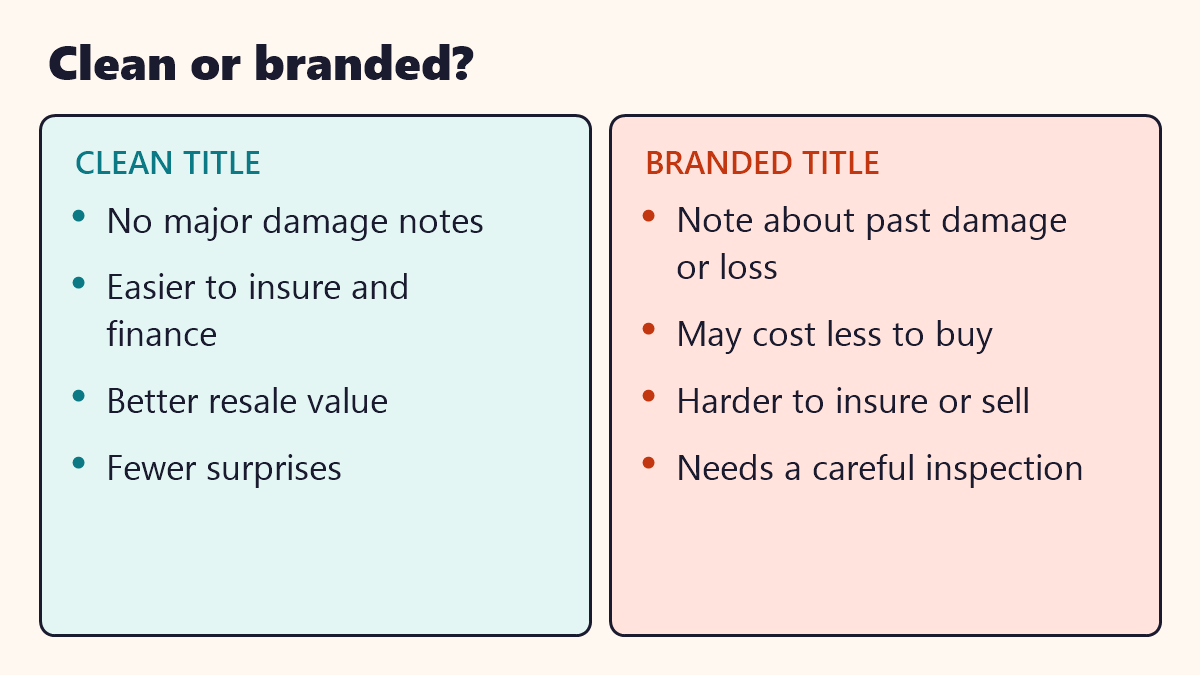
A clean title does not guarantee a perfect car, but it removes one big warning sign. A branded title is not always a bad choice, but you must go in with your eyes open.
How to check a car’s title and history
- Ask to see the title. Look for any brand or note on it.
- Get the VIN. The vehicle identification number is on the dashboard near the windshield and on a door sticker.
- Run a history report. Paid reports and government-backed databases can show title brands and accident records.
- Compare details. Make sure the VIN on the paperwork matches the car.
- Take it to an independent mechanic. Pay for a pre-purchase inspection.
- Check insurance. Call your insurer to ask if they will cover that car.
Should you ever buy a branded-title car?
Some buyers do, usually for a much lower price. A well-repaired rebuilt car can serve many years, and mechanics who can do their own repairs may find value. But the risks are real. If you are not an expert, a car with a clean title is almost always the safer choice. If you do decide to buy, get the repair paperwork, a thorough inspection and a price that reflects the added risk.
If you are selling a car with a branded title
- Be honest about the brand in your listing.
- Gather repair receipts and inspection papers.
- Price the car fairly for its history.
- Expect fewer buyers and be patient.
- Never hide a brand, since doing so can be illegal.
Warning signs of title problems
- The seller cannot show the title or says “it is lost.”
- The title is from a different state with no explanation.
- The price is far below the market with no clear reason.
- The VIN on the car does not match the paperwork.
- The seller rushes you or asks for a deposit before you inspect the car.
Common mistakes
- Buying without a history report. It costs little compared with the risk.
- Trusting the seller’s word alone. Always verify.
- Ignoring an inspection. Damage can hide behind fresh paint.
- Forgetting insurance. Check cover before you buy.
Key takeaways
- A branded title is a permanent note about serious past damage or loss.
- Common brands include salvage, rebuilt, flood, junk and lemon buyback.
- These cars are worth less and can be hard to insure or finance.
- Check the VIN, the title and an independent inspection.
- A clean title is the safer choice for most buyers.
Frequently asked questions
What does a branded title mean?
It means the car’s official title carries a label about past damage, loss or legal issues, such as salvage or flood damage.
Is a branded title the same as a salvage title?
Salvage is one type of brand. A branded title can also be rebuilt, flood, junk or lemon law buyback.
Can a branded title become clean?
Usually not. The brand stays on the record, though a rebuilt car may receive a new “rebuilt” title after inspection.
Is it safe to buy a car with a branded title?
It can be risky. A careful inspection by an independent mechanic and a full history report help, and the price should reflect the risk.
How do I check if a car has a branded title?
Run the car’s VIN through a vehicle history report and ask the seller to show you the title in person.