
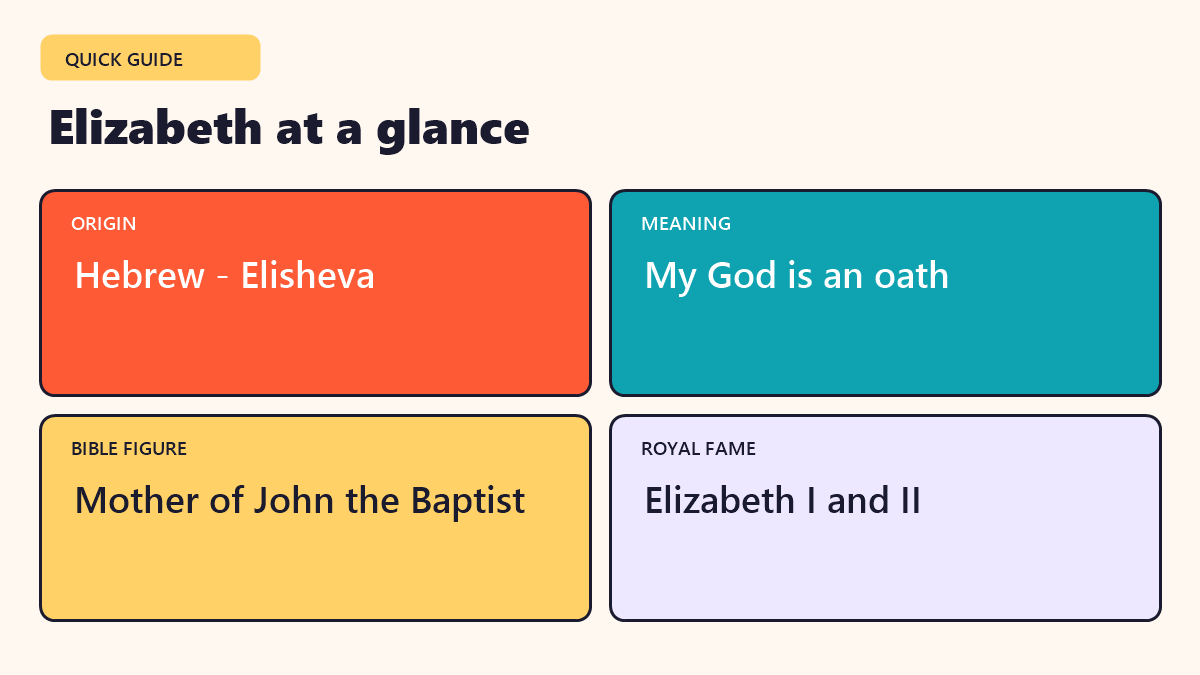
Quick answer: Elizabeth comes from the Hebrew name Elisheva, usually translated as “my God is an oath” or “God is my oath.” It is a Bible name, and it was carried by queens and saints, which made it popular around the world.
Featured image: Photo by Rachel McDermott on Unsplash
Few names have lasted as long as Elizabeth. It appears in the Bible, in the courts of kings and queens and in family trees all over the world. This guide explains what the name means, where it comes from, how it changed in different languages, which nicknames it has and why it has remained popular for so long.
In this guide
What does Elizabeth mean?
Elizabeth comes from the Hebrew name Elisheva. It is made of two parts: El (“God”) and sheva (“oath” or sometimes “seven,” a number that shows completeness). The most common translation is “my God is an oath” or “God is my oath.” Some people also read it as “God is abundance.”
The meaning points to a promise or a promise kept, which is a warm idea for a name.
Elizabeth in the Bible
In the New Testament, Elizabeth is the mother of John the Baptist and a relative of Mary, the mother of Jesus. She is described as a woman of faith who had a child late in life. Because of her story, the name became popular among Christians, and it spread through Europe in the Middle Ages.
Royal and famous Elizabeths
- Elizabeth I ruled England from 1558 to 1603, a time often called the Elizabethan era.
- Elizabeth II reigned as queen of the United Kingdom from 1952 until 2022, the longest reign in British history.
- Elizabeth Taylor was a famous film actress.
- Elizabeth Barrett Browning was a well-known English poet.
These women kept the name in public view for hundreds of years.
Elizabeth around the world
| Language | Form | Notes |
|---|---|---|
| Hebrew | Elisheva | The original form |
| Greek | Elisabet | Used in the Greek New Testament |
| Spanish | Isabel, Elisabet | Isabel is a short, popular form |
| Italian | Elisabetta, Isabella | A romantic, musical sound |
| French | Élisabeth | Often shortened to Élise |
| German | Elisabeth | Short form Lisa or Liesel |
| Russian | Yelizaveta | Short form Liza |
Many of these have become independent names that people now give to children without thinking of Elizabeth at all.
Nicknames and short forms
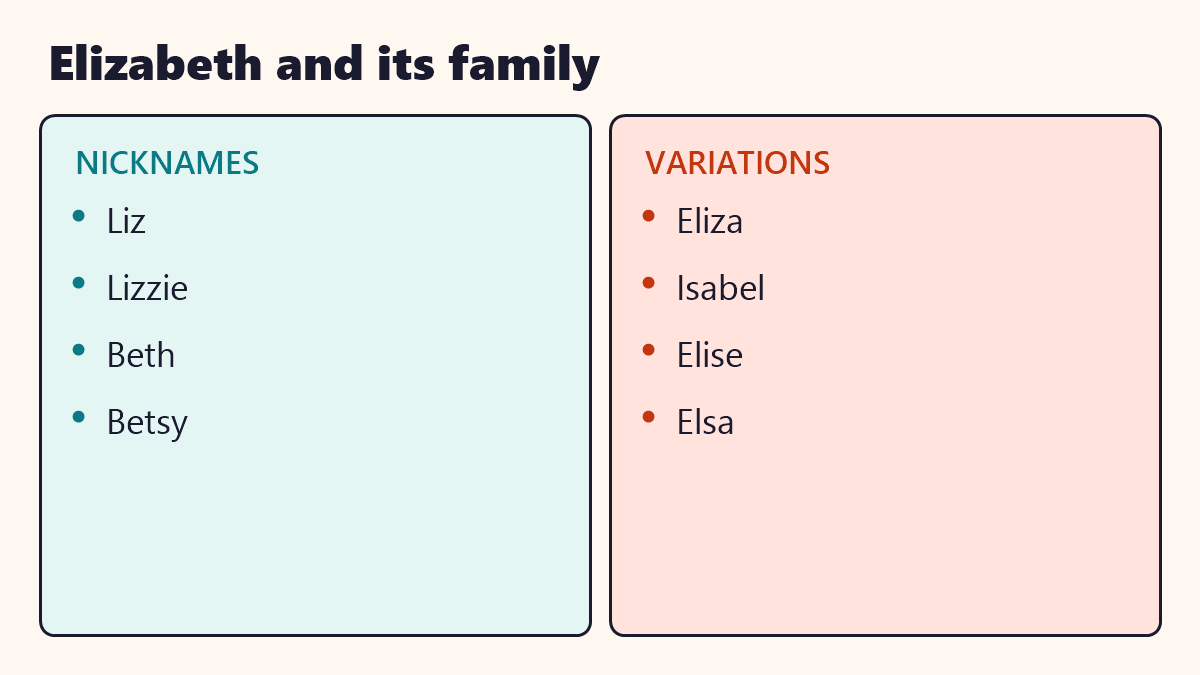
- Liz, Lizzie and Lizzy: classic and friendly
- Beth and Bethany: softer and more gentle
- Betsy, Betty and Bessie: older, charming forms
- Libby: light and playful
- Eliza, Elise and Ellie: modern favorites
- Lisa and Liesel: short forms used in other languages
One name, many personalities. A girl named Elizabeth can be Liz at work, Beth with her friends and Lizzie with her grandparents.
Choosing the name Elizabeth
Elizabeth is a great choice if you like a classic name with many options. It is easy to read, easy to spell and pairs well with many middle names. Try combinations like Elizabeth Rose, Elizabeth Claire or Elizabeth Jane, and say the full name aloud.
Fun facts about the name Elizabeth
- Its Hebrew meaning links to ideas of promise and faith.
- The nickname Betty comes from a childlike form of Elizabeth, which shows how old nicknames can be.
- The name works across religions and cultures, so it appears in many countries.
- Spelling can change to Elisabeth, with an “s,” in many European languages.
Common mistakes
- Assuming it only means “God’s promise.” The translation “my God is an oath” is the most accepted.
- Mixing up Elizabeth and Isabella. Isabella is a related form, but it is its own name now.
- Using a nickname before asking. Some people only use the full name.
- Forgetting spelling forms. Elisabeth with an “s” is correct in many places.
Key takeaways
- Elizabeth comes from Hebrew Elisheva and means “my God is an oath.”
- It is the name of the mother of John the Baptist in the Bible.
- Elizabeth I and Elizabeth II made it famous.
- Nicknames include Liz, Beth, Betsy, Eliza and Libby.
- It has beautiful variations around the world, including Isabel and Elise.
Frequently asked questions
What does the name Elizabeth mean?
Elizabeth is usually translated as “my God is an oath” or “God is my oath.” It comes from the Hebrew name Elisheva.
Where does Elizabeth come from?
It comes from Hebrew through Greek and Latin forms. In the Bible, Elizabeth is the mother of John the Baptist.
What are nicknames for Elizabeth?
Liz, Lizzie, Beth, Betsy, Betty, Libby, Eliza and Ellie are common nicknames.
Is Isabella a form of Elizabeth?
Yes. Isabel and Isabella are Spanish and Italian forms of Elizabeth.
Which queens were named Elizabeth?
Elizabeth I ruled England from 1558 to 1603, and Elizabeth II reigned from 1952 to 2022.