
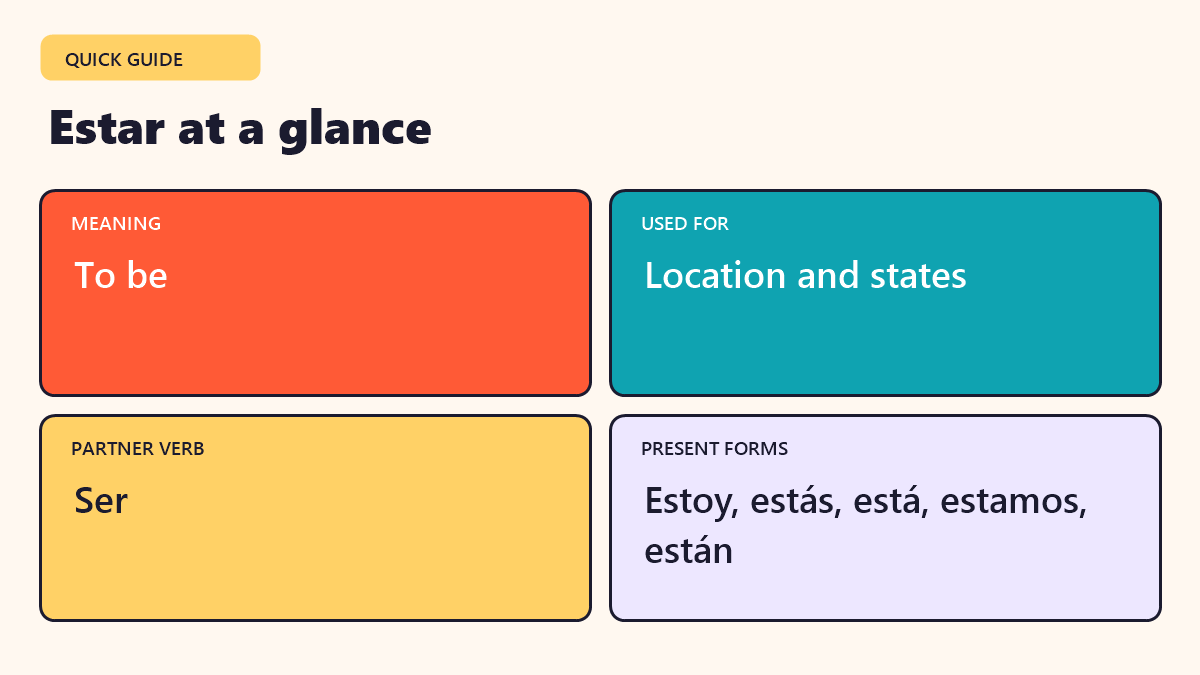
Quick answer: Estar means “to be” in Spanish. You use it for where something is and for feelings, conditions and temporary states. For who or what something is by nature, you use its partner verb, ser.
Featured image: Photo by Matias North on Unsplash
Spanish has two verbs that mean “to be”: ser and estar. English has just one, so many learners find this confusing. The good news is that estar has a clear job. This guide shows what estar means, how to use it and how to tell it apart from ser.
In this guide
What does estar mean?
Estar means “to be,” and it points to location and state. If you can answer the question “Where is it?” or “How is it right now?” you probably need estar.
Amigo: ¿Dónde estás?
Tú: Estoy en casa.
Amigo: ¿Cómo estás?
Tú: Estoy cansado.
The present tense of estar
| Person | Spanish | English |
|---|---|---|
| Yo | estoy | I am |
| Tú | estás | You are |
| Él / ella / usted | está | He, she, you (formal) are |
| Nosotros | estamos | We are |
| Vosotros | estáis | You (plural, Spain) are |
| Ellos / ellas / ustedes | están | They, you (plural) are |
Notice the accent marks on estás, está and estáis. They show where the stress falls in the word.
When to use estar
A handy memory trick is the word PLACE:
- Position and Location: “El libro está en la mesa.”
- Action in progress: “Estoy comiendo.”
- Condition: “La puerta está abierta.”
- Emotion: “Estoy feliz.”
Almost every use of estar fits one of these five ideas.
When to use ser instead
For ser, many teachers use the word DOCTOR: Description, Occupation, Characteristic, Time, Origin and Relationship. For example, “Soy profesor” (I am a teacher), “Es de México” (he is from Mexico) and “Son las tres” (it is three o’clock).

A short rule: ser tells what something is, estar tells how or where it is.
Words that change meaning
| With ser | With estar |
|---|---|
| Es aburrido: He is boring | Está aburrido: He is bored |
| Es listo: He is clever | Está listo: He is ready |
| Es malo: He is bad | Está malo: He is sick |
| Es seguro: It is safe | Está seguro: He is sure |
These pairs show how a tiny change of verb gives a very different meaning. They are worth memorizing.
Estar with -ing forms
To say what is happening right now, Spanish uses estar plus a verb that ends in -ando or -iendo. For example, “Estoy estudiando” (I am studying), “Estamos cocinando” (We are cooking), “Están jugando” (They are playing).
Common mistakes
- Using ser for location. Say “Estoy en el parque,” not “Soy en el parque.”
- Using estar for origin. Say “Soy de Chile,” not “Estoy de Chile.”
- Forgetting accents. Write está, estás and están with accents.
- Mixing up meanings. “Es aburrido” and “está aburrido” are not the same.
- Using estar for permanent traits. Use ser for things like height or nationality.
Tips for learning estar
- Learn the six present forms by heart.
- Remember PLACE for estar and DOCTOR for ser.
- Practice with simple questions: “¿Dónde estás? ¿Cómo estás?”
- Read short Spanish texts and highlight each form of ser and estar.
- Say a sentence aloud every day with the verb “estar.”
Key takeaways
- Estar means “to be” for location, feelings and temporary states.
- The present forms are estoy, estás, está, estamos, estáis, están.
- Ser describes identity, origin, jobs and traits.
- Some adjectives change meaning with ser or estar.
- The PLACE and DOCTOR tricks help you decide.
Quick drill: fill in the blank
| Sentence | Missing word | Why |
|---|---|---|
| Yo ___ en la cocina. | estoy | Location, use estar |
| Ella ___ profesora. | es | Occupation, use ser |
| Nosotros ___ cansados. | estamos | Temporary feeling, use estar |
| Son las ___ tres de la tarde. | (no blank, time uses ser) | Time always uses ser |
A memory trick for the accent marks
Learners often forget the accents on estás, está, and estáis. One simple trick: say the word slowly and stretch the stressed syllable. If the stress naturally falls on the second-to-last syllable where Spanish spelling rules would not expect it, that mismatch is exactly why an accent mark exists, to show the reader where to place emphasis.
Frequently asked questions
What does estar mean in Spanish?
Estar means “to be.” It is used for location, feelings and temporary conditions.
What is the difference between ser and estar?
Ser describes who or what something is by nature. Estar describes where it is or how it is right now.
How do you conjugate estar?
In the present tense: yo estoy, tú estás, él/ella está, nosotros estamos, vosotros estáis, ellos están.
Why does estar change a meaning?
Some adjectives change meaning. “Es aburrido” means he is boring, while “está aburrido” means he is bored.
Is estar irregular?
Yes. Its present forms (estoy and the accented forms) do not follow the regular pattern, so learners memorize them.