
Quick answer: HBU stands for “how about you?” It is a quick way to return a question, such as “I am good, hbu?” It keeps a conversation going and shows you care about the other person’s answer.
Featured image: Photo by Toa Heftiba on Unsplash
“I am good, hbu?” is one of the most common lines in modern texting. If you have ever wondered what it means or how to answer it without sounding dull, this guide gives you the meaning, the manners and some easy examples you can copy.
In this guide
What does HBU mean?
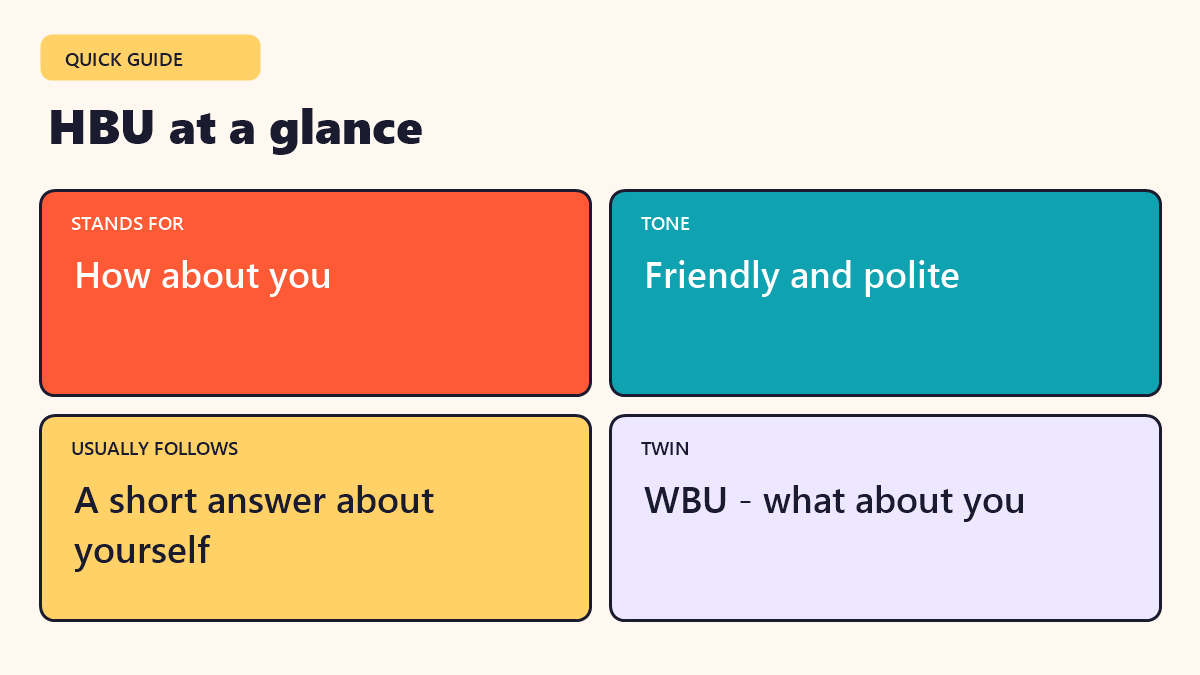
HBU stands for “how about you?” You add it after answering a question, to ask the same thing back. If someone asks how you are doing and you answer “good,” adding “hbu?” invites them to share too.
It is quick, friendly and a little bit lazy in the best way. Nobody wants to type a long sentence for a simple question, so HBU fits well.
Where does HBU come from?
“How about you?” has been a common phrase for generations, and it was shortened as chat rooms and phones made typing quicker. HBU sits next to other short forms like BRB and BTW. It is now so common that people use it in voice-to-text too.
Examples of HBU in real chats
Friend: How was your weekend?
You: Pretty relaxed, watched a movie. Hbu?
New match: What do you do for fun?
You: I like hiking and cooking. Hbu?
Classmate: Which class is hardest?
You: Chemistry for me, hbu?
In each case the sender gives a real answer first and then returns the question. That small habit is what makes HBU feel friendly.
HBU vs WBU
WBU means “what about you?” It does the same job, and people choose between them by habit. A few differences show up in practice:
- HBU often follows “how” questions, like “How are you?”
- WBU often follows “what” questions, like “What are you doing tonight?”
- Both are casual and both are understood everywhere.
How to reply to HBU
A good reply has two parts: an honest answer and a little extra.
- Simple: “Doing well, just finished work.”
- With a detail: “Pretty tired, but I am off tomorrow, so I am happy.”
- With a question: “I am good. Any plans for the weekend?”
Avoid replying with only “good” and nothing more, because the chat can stall.
When HBU helps, and when to try something else
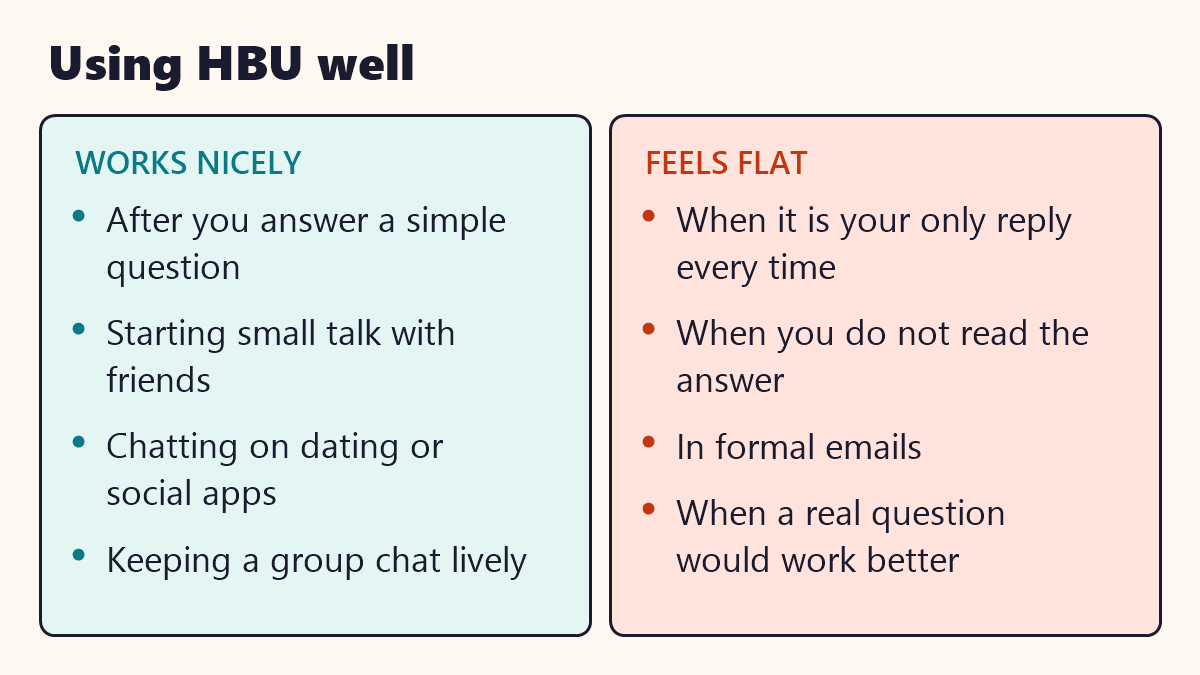
If you notice that every message in a chat ends with HBU, mix it up. Specific questions like “What was the best part of your day?” show real interest and lead to better talks.
Better conversation starters than HBU
- What was the best part of your day?
- Have you watched or read anything good lately?
- Any plans you are looking forward to?
- What is something small that made you smile this week?
- What is your go-to snack right now?
HBU on dating apps and first chats
On dating apps and when you first talk to someone new, HBU is a friendly bridge. It lets you share something small and then ask the other person to do the same. That back-and-forth is how most good conversations start.
Match: Hey! How is your week going?
You: Busy but good, I started a pottery class. Hbu?
Notice that the reply gives the other person something to ask about, the pottery class. That is much better than “good, hbu?” because it gives them an easy next question.
Short, medium and long replies
| Style | Example | Best for |
|---|---|---|
| Short | “Good, hbu?” | Quick chats with close friends |
| Medium | “Good, just finished work. Hbu?” | Everyday conversations |
| Long | “Pretty good! Work was busy, but I am meeting friends tonight. How about you, any plans?” | New friends and dating chats |
Mixing the styles keeps you from sounding like a robot. Match the energy of the person you are talking to.
Common mistakes with HBU
- Using it as your only message. Without an answer, it feels like you are making the other person do all the work.
- Not reading the reply. If someone shares something big, respond to it, do not just move on.
- Using it when you do not care. People can tell.
- Overusing it. A better question now and then makes you more interesting.
Key takeaways
- HBU means “how about you?”
- Use it after you answer a question, not instead of one.
- WBU means the same thing.
- Add a detail or a new question to keep the chat alive.
- Spell it out in formal messages.
Frequently asked questions
What does HBU mean in text?
HBU means “how about you?” It is a short way to ask the other person the same question you just answered.
What is the difference between HBU and WBU?
They mean almost the same thing. HBU is “how about you” and WBU is “what about you.”
How do I reply to HBU?
Answer the question honestly in a short sentence, and then add a small detail or ask something new.
Is HBU flirty?
Not by itself. It is simply polite small talk. The tone of the rest of the chat decides if it feels flirty.
Can I use HBU at work?
In casual messages with friendly coworkers it is fine. For formal emails, write “How about you?” in full.