
Quick answer: ICL stands for “I can’t lie.” People type it before an honest opinion or a small confession, such as “ICL, that was better than I expected.” It is casual, friendly and usually positive.
Featured image: Photo by Brooke Cagle on Unsplash
You are chatting with a friend, and she writes, “icl, that outfit looks amazing.” You smile, but you wonder about the first word. ICL is a small abbreviation that shows up all the time in modern chats. This guide explains what it means, how it feels and how to use it without sounding fake.
In this guide
- What does ICL mean?
- Where does ICL come from?
- How people use ICL
- ICL, NGL, TBH: what is the difference?
- When to use ICL and when to skip it
- How to reply to ICL
- Other meanings of ICL
- Tips for using ICL naturally
- ICL in different situations
- Why honesty phrases are so popular
- Common mistakes with ICL
- Key takeaways
What does ICL mean?
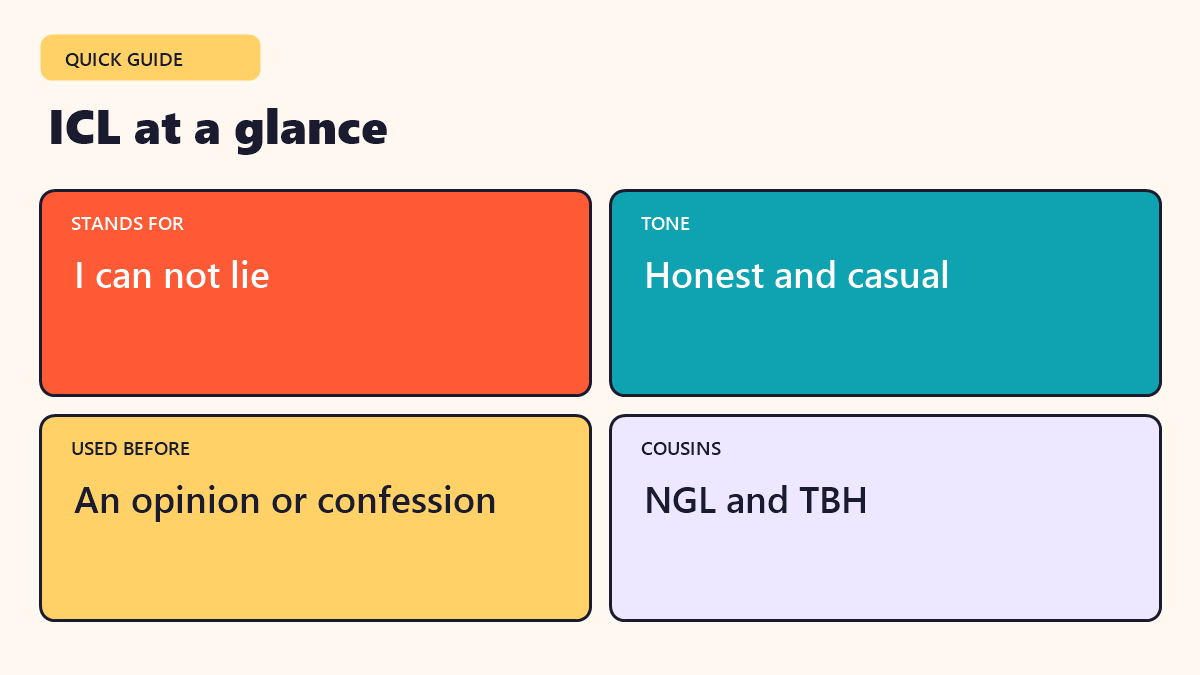
ICL means “I can’t lie.” It tells the reader that an honest thought is coming. The speaker is saying, “I will be real with you.”
People use it in two main ways: to give an honest opinion, as in “icl, that was a great show,” and to confess something small, as in “icl, I forgot to study.”
Where does ICL come from?
The phrase “I can’t lie” has been part of everyday speech and song lyrics for a long time, usually to say “I have to admit.” Online, it was shortened to ICL, much like “to be honest” became TBH. It spread through group chats, video comments and gaming voice chat, mainly among younger people.
How people use ICL
To give an honest opinion
Friend: Did you like the new album?
You: icl, I played it three times already.
To admit something small
Friend: Did you finish the book?
You: icl, I only read the first chapter.
To pay a real compliment
Friend: Do I look okay?
You: icl, you look great.
In most cases ICL makes the message feel warm and trusting. The writer is telling you that they are not hiding anything.
ICL, NGL, TBH: what is the difference?
| Phrase | Meaning | Typical feeling |
|---|---|---|
| ICL | I can not lie | Honest, a little confessional |
| NGL | Not gonna lie | Blunt, sometimes surprised |
| TBH | To be honest | Frank, a neutral opinion |
| TBF | To be fair | Balanced and thoughtful |
| FR | For real | Strong agreement |
These phrases overlap a lot. ICL tends to sound softer than NGL, and it often comes before a pleasant surprise. People often use all of them without thinking much about the small differences.
When to use ICL and when to skip it
ICL is simple to use, but context still matters. Here is a quick guide.
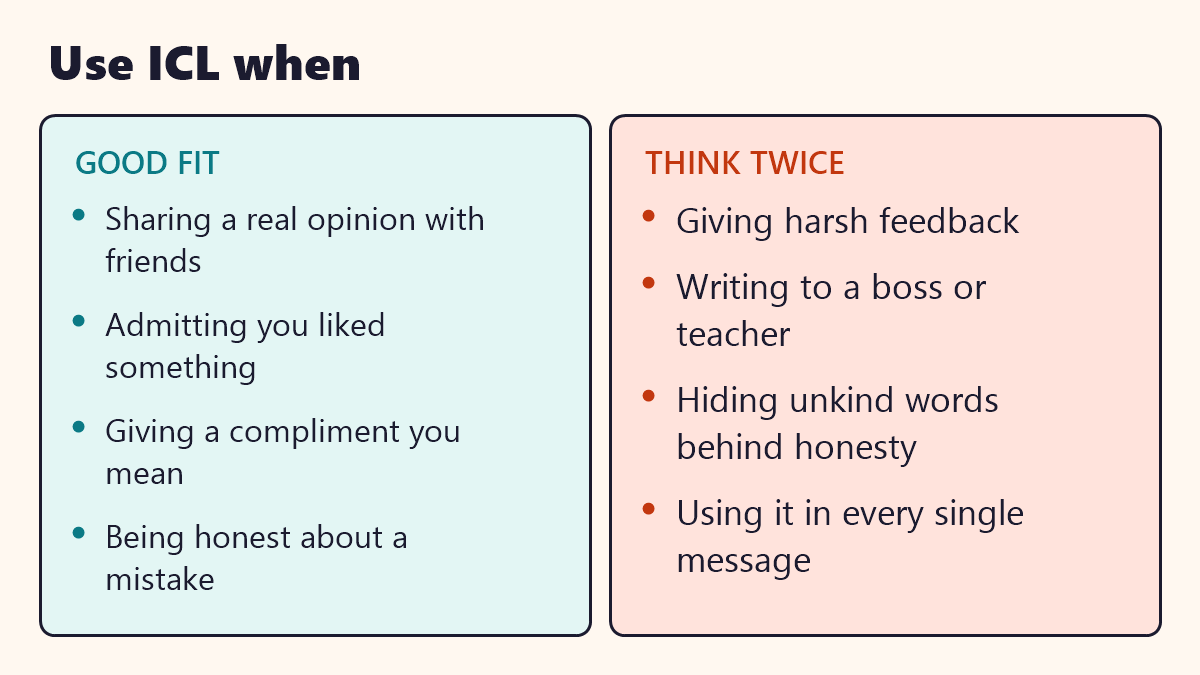
Honesty is good, but do not use “ICL” as a shield for hurtful words. Saying “icl, your idea is bad” is still unkind, even with the little label in front.
How to reply to ICL
- When it is a compliment: “Aw, thank you!”
- When it is a confession: “Ha, same, honestly.”
- When you disagree: “I get that, but I liked it more than you.”
- When you want more detail: “Why do you say that?”
Other meanings of ICL
Outside of chats, ICL can stand for implantable collamer lens, a small lens placed inside the eye to correct vision. If you see it in a message from an eye doctor, that is the meaning. You may also see it as the short name of some companies. In a casual chat with friends, it almost always means “I can’t lie.”
Tips for using ICL naturally
- Use it only when you really mean the honest part.
- Keep it to once in a message.
- Pair it with kindness when the news is not great.
- Do not use it in formal emails or school work.
- If someone seems upset, drop the slang and speak plainly.
ICL in different situations
Between friends
This is where ICL is most common. It keeps the mood relaxed: “icl, I laughed so hard at that video.”
In group chats
People use it to share an opinion with a crowd without sounding too strong. “Icl, I think pizza wins” feels more like an invitation to talk than a rule.
In reviews and comments
Under videos and posts, you will often see “icl, this song is so good.” Here it works as a short, honest review.
With people you do not know well
Be a little more careful. A confession like “icl, I did not like it” can sound blunt to someone you have just met. Soften it: “Honestly, it was not for me, but I can see why people like it.”
Why honesty phrases are so popular
Modern chats are fast and short, and people often worry about sounding fake. Phrases like ICL, NGL and TBH act as little signals that say “this is real.” They also soften a message, because the person is admitting a feeling, not attacking someone. That mix of honesty and kindness is why these small phrases spread so quickly.
Common mistakes with ICL
- Hiding unkind words behind it. “Icl, you look bad” is still hurtful.
- Using it for obvious things. “Icl, the sky is blue” sounds odd.
- Using it in formal writing. Teachers and managers may not know the slang.
- Mixing too many honesty phrases. “Icl ngl tbh” in one line looks like filler.
Key takeaways
- ICL means “I can’t lie.”
- It introduces an honest opinion or a small confession.
- It is similar to NGL and TBH and usually sounds warm.
- It is best with friends, not in formal writing.
- It can mean implantable collamer lens in eye care.
Frequently asked questions
What does ICL mean in text?
ICL means “I can’t lie.” It introduces an honest comment or confession.
Is ICL the same as NGL?
They are close. NGL means “not gonna lie” and ICL means “I can’t lie.” Both signal honesty, and people use them in almost the same way.
Is ICL slang for something rude?
No. It is a casual, neutral phrase. The rest of the sentence decides if the message is kind or blunt.
Can ICL mean something else?
Yes. In eye care, ICL stands for implantable collamer lens, a type of vision correction lens. The context makes it clear.
Where did ICL start?
The phrase “I can’t lie” has long been used in spoken English and song lyrics. Texting and social media turned it into ICL.