
Quick answer: Lowkey means “a little,” “somewhat” or “in a quiet way.” Saying “I lowkey want pizza” means you want pizza, but you are not making a big deal about it. It can also mean something is kept quiet, like a lowkey party.
Featured image: Photo by Vitaly Gariev on Unsplash
You hear someone say, “I lowkey love this song,” and you wonder: if they love it, why “lowkey”? The answer is that lowkey adds a soft, relaxed feel to a statement. It is one of the most useful slang words of the last decade, and this guide shows exactly how it works.
In this guide
What does lowkey mean?
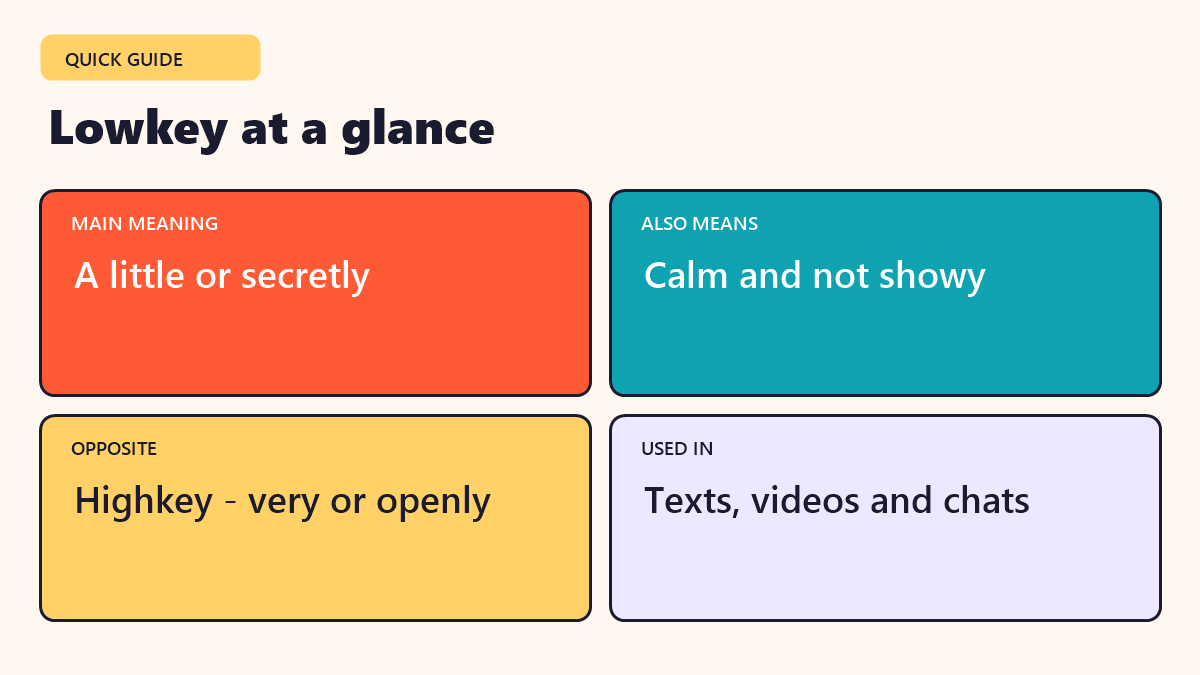
In slang, lowkey means “a little,” “kind of” or “in a quiet way.” It lowers the volume of a feeling. When you say “I lowkey want pizza,” you want pizza, but you are mentioning it casually. When you say “I lowkey did not like the ending,” you are giving a small, gentle opinion.
It also has a second meaning, the older one: something calm, simple and not flashy. A “low-key dinner” means a relaxed dinner without fuss.
Where does lowkey come from?
The word “low-key” has long described things that are restrained and quiet, like a low-key celebration. In recent years, young people online began using “lowkey” as a casual adverb to describe feelings and secrets. It spread through social media, rap lyrics and group chats, and then moved to everyday speech.
How people use lowkey
To admit a small feeling
Friend: Are you excited for the trip?
You: Lowkey yes, but I am also nervous.
To soften an opinion
Friend: Did you like the movie?
You: It was lowkey too long.
To share a secret like
Friend: Do you watch reality shows?
You: Lowkey obsessed.
In the last example, “lowkey obsessed” is a playful twist. The word says “quietly,” but the feeling is strong. That small contrast is part of the humor.
Lowkey vs highkey
| Word | Meaning | Example |
|---|---|---|
| Lowkey | A little, quietly | “I lowkey need a nap.” |
| Highkey | Very, openly | “I highkey love this song.” |
| No cap | No lie, for real | “That was no cap the best show.” |
| Kinda | Somewhat | “It was kinda boring.” |
You can use them together for contrast: “I lowkey like it, but my friend highkey loves it.” Highkey is less common, but it sits at the other end of the same scale.
How to use lowkey in a sentence
- Put it before the verb or adjective: “I lowkey miss school.”
- Use it to soften: “That plan is lowkey risky.”
- Use it for a secret: “I lowkey ship them.”
- Keep it short and casual.
- Use it once per message, not in every sentence.
Using lowkey with care
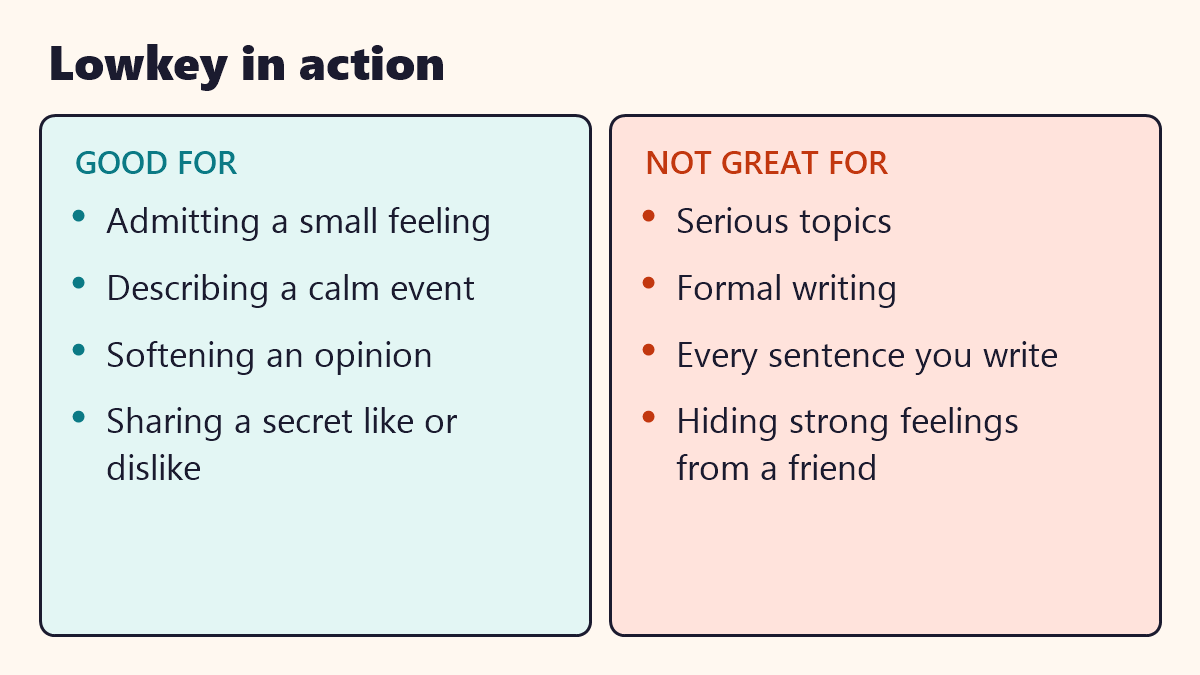
Like all slang, lowkey fits some places better than others. In a job interview or a school essay, use plain words like “somewhat” or “a little.”
Lowkey in different situations
| Situation | Example | What it shows |
|---|---|---|
| Food | “I lowkey want fries.” | A quiet craving |
| School | “I lowkey like that class.” | A small, surprising opinion |
| Friends | “I lowkey missed you.” | A soft, caring feeling |
| Events | “A lowkey birthday dinner.” | A simple, relaxed celebration |
| Opinions | “This is lowkey unfair.” | A gentle complaint |
Notice that the word usually comes just before the verb or adjective. It rarely appears at the end of a sentence.
Lowkey, low-key and spelling
You will see both “lowkey” and “low-key.” In slang texts, most people write one word without a hyphen. In standard writing, the hyphenated “low-key” is the common form, as in “a low-key evening.” Both spellings are understood, so choose the one that fits the setting.
Words that work like lowkey
- Kind of / kinda: “I kinda want to go.”
- Sort of: “I sort of agree.”
- Honestly: “Honestly, I liked it.”
- A bit: “I am a bit tired.”
- Secretly: “I secretly love that song.”
If you want a gentle tone without slang, any of these will do the job in formal or mixed company.
Practice: rewrite these sentences
| Plain sentence | With lowkey |
|---|---|
| I am a little tired. | I am lowkey tired. |
| I secretly want to go. | I lowkey want to go. |
| The party was small and relaxed. | It was a lowkey party. |
| I sort of like that idea. | I lowkey like that idea. |
Common mistakes with lowkey
- Using it for strong feelings that you mean to show. If you love someone, “lowkey love” sounds odd.
- Overusing it. A chat full of lowkey sounds fake.
- Mixing it up with “low-key” in formal writing. Use the standard word “low-key” there.
- Using it as a way to hide. If your feelings matter, say them clearly.
Key takeaways
- Lowkey means “a little,” “somewhat” or “quietly.”
- Highkey is the opposite, meaning “very” or “openly.”
- It softens statements and adds a relaxed tone.
- It also describes calm, simple events.
- Use it lightly, and avoid it in formal writing.
Frequently asked questions
What does lowkey mean in slang?
In slang, lowkey means “somewhat,” “a little” or “secretly.” It softens how strong a feeling sounds.
What does highkey mean?
Highkey is the opposite. It means “very” or “openly,” as in “I highkey love this song.”
Is lowkey the same as low-key?
Almost. The older word “low-key” means calm and not showy. Slang “lowkey” also works as an adverb that means “a bit.”
Where does lowkey come from?
The older word has long described quiet, restrained things. Online communities turned it into slang for subtle feelings.
Is lowkey still popular?
Yes. It is one of the most common Gen Z words and has also spread to older speakers.