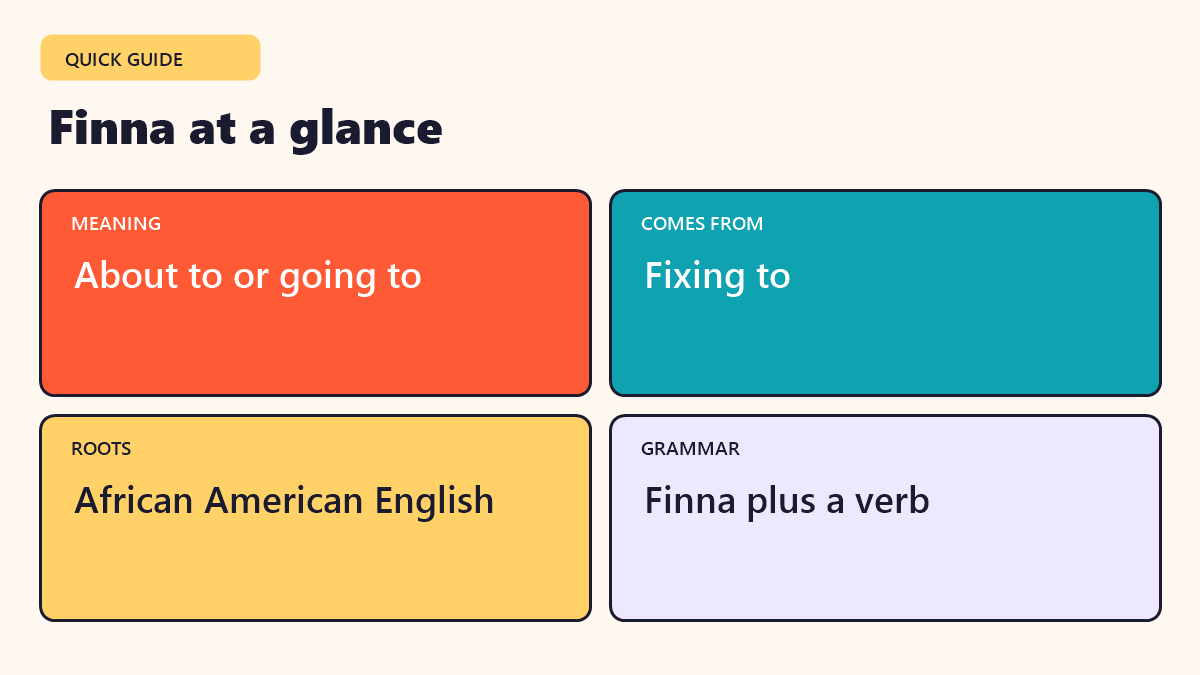
Quick answer: Finna means “about to” or “going to.” People say “I’m finna eat” to mean “I am about to eat.” The word comes from “fixing to” and has deep roots in African American English and Southern speech.
Featured image: Photo by Jakub Żerdzicki on Unsplash
You see a message that says, “I’m finna head out,” and you wonder what the word means. Finna is common in songs, social media and everyday talk. This guide explains what it means, where it came from and how to use it in a respectful and natural way.
In this guide
What does finna mean?
Finna means “about to” or “going to.” It is followed by a verb that tells what is about to happen. “I’m finna go to the store” means “I am about to go to the store.” “We finna eat” means “We are about to eat.”
The word often points to something that will happen very soon, which is a small difference from “gonna,” a word that can mean any time in the future.
Where does finna come from?
Finna comes from the phrase “fixing to,” which means “getting ready to.” “Fixing to” is common in the Southern United States, and its short form, “finna,” has long been used in African American English. Linguists describe it as a natural, regular part of that dialect, not a mistake or lazy speech.
In recent years, social media and music carried finna to speakers all over the world. That is why you now see it in memes, comments and even advertising.
How to use finna
Finna goes before a verb. A few rules help:
- Say it before an action: “I’m finna call her.”
- You can leave out the subject in casual speech: “Finna go to sleep.”
- Use it for the near future, not the past.
- Do not add “to” after it. Say “finna eat,” not “finna to eat.”
Examples
Friend: Where are you?
You: Finna leave now.
Friend: Are you busy?
You: Nah, I’m finna watch a movie. Want to join?
Friend: What is the plan?
You: We finna order food.
Finna vs gonna vs about to
| Phrase | Meaning | Time frame |
|---|---|---|
| Finna | About to | Very soon |
| Gonna | Going to | Any time later |
| About to | Going to very soon | Standard English |
| Fixing to | Getting ready to | Soft Southern form |
| Tryna | Trying to | Showing intent |
In formal English, the best choice is “about to.” Finna lives in casual talk.
Using finna with respect
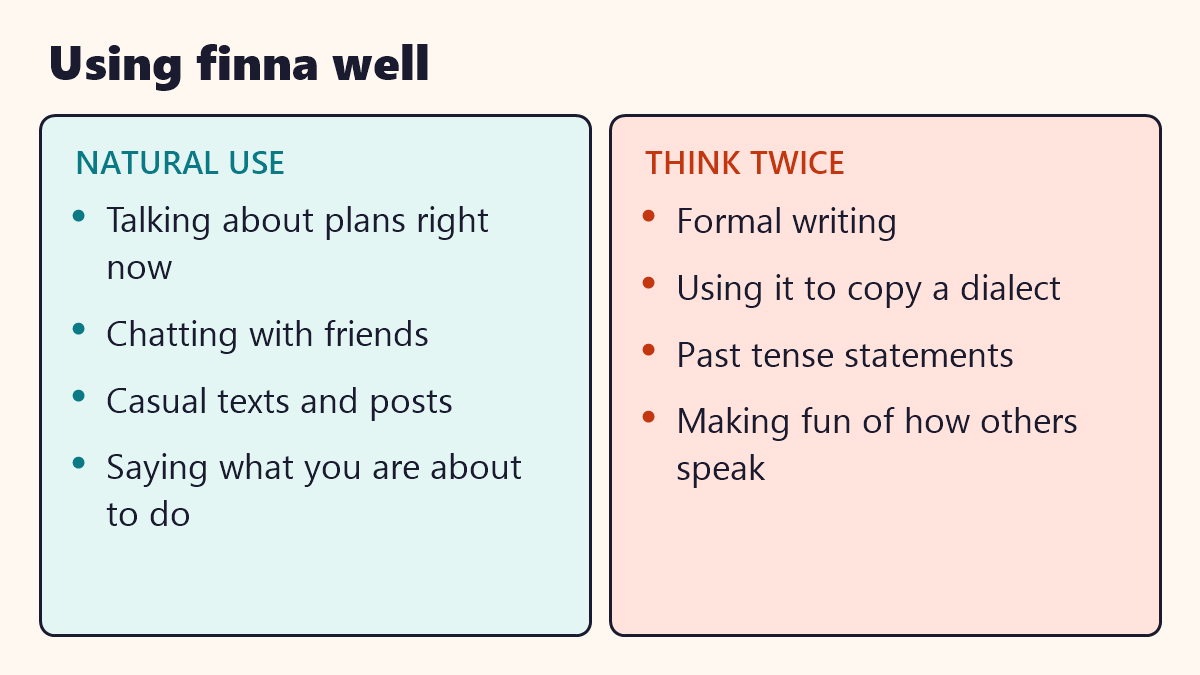
Slang from African American English often becomes popular and then loses its roots. Many people feel that using it without understanding where it came from is unfair, especially when it is used as a joke or put in a fake accent. The best approach is simple: if finna fits naturally in your own speech, use it. If you only want to imitate a style, skip it.
Finna and its relatives
| Form | Meaning | Where you hear it |
|---|---|---|
| Finna | About to | African American English, social media |
| Fixing to / fixin’ to | Getting ready to | Southern American English |
| Bouta | About to | Casual chat and texts |
| Tryna | Trying to | Casual chat and texts |
| Gonna | Going to | Everywhere |
These forms are close cousins. They shorten longer phrases so speech can flow quickly. Linguists often point out that every language does this, and English has done it for centuries with words like “going to” becoming “gonna.”
Finna in regional speech
In the Southern United States, many people use “fixing to” in everyday talk, as in “I am fixing to cook dinner.” Over time, speakers shortened it, and the form “finna” became common in many Black communities. Today you can hear it in cities and small towns, in music and on streaming platforms. The core meaning stays the same no matter the accent.
Examples across different places
Friend: You at school?
You: Finna walk in now.
Coworker: Are you leaving soon?
You: Yeah, finna wrap up and head out.
Sibling: What is for dinner?
You: I’m finna make pasta.
Why dialect words deserve respect
Dialects are not “bad English.” They have rules, history and meaning. When a dialect word spreads to people who did not grow up with it, the nicest thing you can do is learn where it comes from and use it as naturally as you can. That keeps the word meaningful and avoids turning someone’s everyday speech into a joke.
Common mistakes with finna
- Using it in the past. “I was finna go” works in some speech, but “I finna went” does not.
- Adding “to.” “Finna to go” is not standard.
- Using it in formal writing. Use “about to” instead.
- Using it as a costume. Fake accents can offend people.
Key takeaways
- Finna means “about to” or “going to.”
- It comes from “fixing to” and has strong roots in African American English.
- Use it before a verb and for the near future.
- Choose “about to” in formal writing.
- Use it naturally and with respect.
Frequently asked questions
What does finna mean?
Finna means “about to” or “going to.” It is followed by a verb, as in “I’m finna leave.”
Where does finna come from?
It comes from “fixing to,” a phrase used in African American English and in Southern American English.
Is finna the same as gonna?
They are close. “Gonna” is about a future plan, while “finna” often means the action is about to happen very soon.
Is finna proper English?
It is a real feature of spoken dialects, but not used in formal writing. Use “about to” in essays and work emails.
Can anyone use finna?
Yes, but it helps to respect its roots and use it naturally, not as a joke or a costume.