
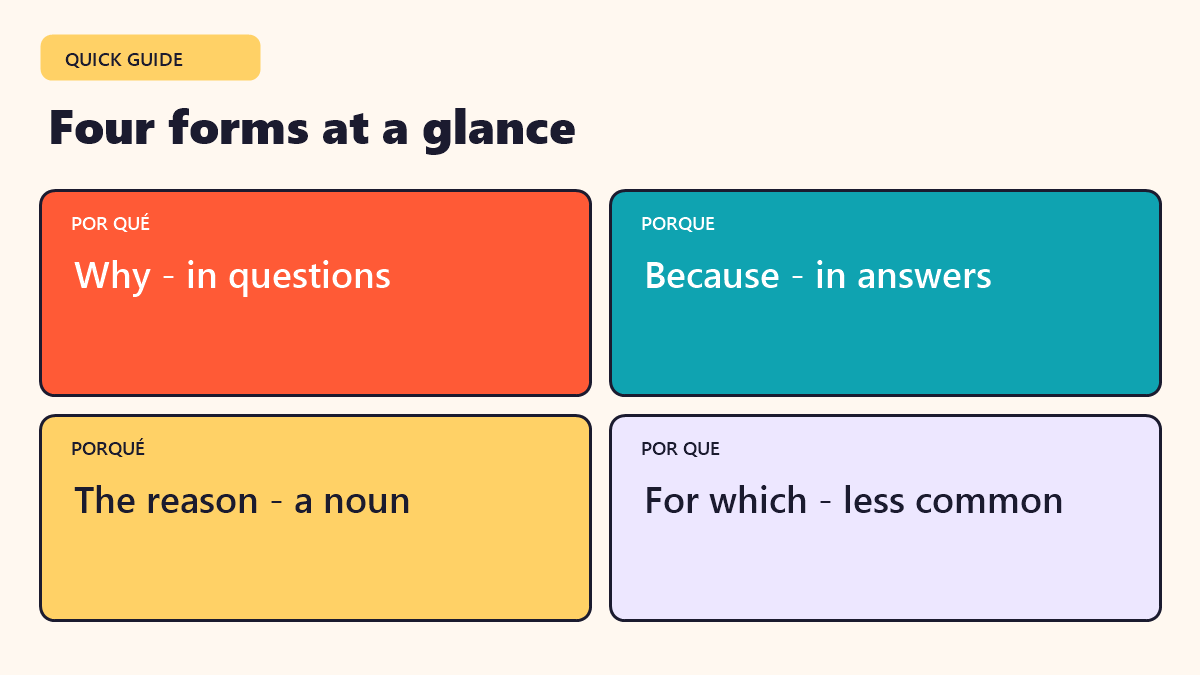
Quick answer: Por qué means “why” (a question). Porque means “because” (an answer). Porqué means “the reason” (a noun). Por que is a less common form that means “for which” or “so that.”
Featured image: Photo by lilartsy on Unsplash
Few Spanish learners escape this trap: por qué, porque, porqué and por que. They look and sound almost the same, yet they mean different things. The good news is that each one has a simple job. This guide gives you a clear rule and plenty of examples.
In this guide
The four forms in one table
| Form | Meaning | Part of speech | Example |
|---|---|---|---|
| Por qué | Why | Question word | ¿Por qué llegaste tarde? |
| Porque | Because | Conjunction | Llegué tarde porque perdí el autobús. |
| Porqué | The reason | Noun | No entiendo el porqué de tu decisión. |
| Por que | For which, so that | Preposition plus que | Esta es la razón por que me fui. |
The sound is nearly identical in speech, so the difference only shows in writing.
Por qué: asking “why?”
Use por qué (two words, with an accent) when you ask a question or when you talk about a question indirectly.
Amigo: ¿Por qué estás triste?
Tú: No sé por qué me siento así.
In the second sentence there is no question mark, but the words still ask “why.” That is why the accent stays.
Porque: giving a reason
Use porque (one word, no accent) when you give a reason or answer a “why” question. It means “because.”
Amigo: ¿Por qué no vienes?
Tú: Porque tengo que trabajar.
A useful trick is that “porque” has the same job as “because.” If you can swap in “because,” you are probably writing it right.
Porqué: the reason
Use porqué (one word, with an accent) as a noun that means “the reason” or “the cause.” It usually has “el” or “un” before it.
- El porqué de su enojo no está claro. (The reason for his anger is not clear.)
- Quiero saber el porqué de tu silencio. (I want to know the reason behind your silence.)
- No hay un porqué para todo. (There is not a reason for everything.)
This form is the least common of the four, and you will mostly see it in writing.
Por que: the quiet fourth form
Por que is two words without an accent. It is made up of the word por (for or by) and the word que (that or which). You see it in two common patterns:
- After a verb that needs “por,” and followed by a clause: Lucharemos por que haya paz. (We will fight so that there is peace.)
- Where it means “por el que” or “por la que”: Esta es la razón por que me fui. (This is the reason for which I left.)
Many writers use “por la que” or “por el que” instead, which is easier to read. Do not worry if you rarely use “por que” yourself.
A quick test you can use
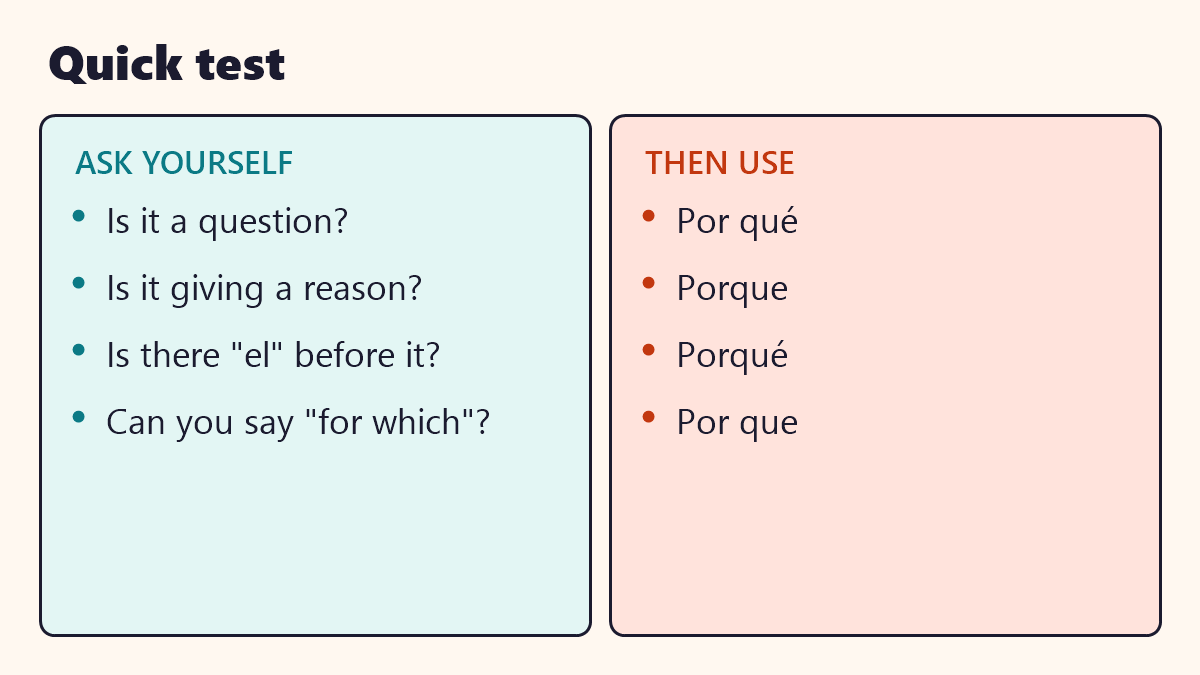
When you are stuck, go through the questions in order. The first one that fits is your answer.
Common mistakes
- Writing “porque” in questions. Say “¿Por qué?” not “¿Porque?”
- Forgetting the accent in “por qué.” The accent marks a question word.
- Using “porqué” as “because.” It is a noun, not a conjunction.
- Overthinking “por que.” If nothing else fits, check whether “for which” works.
Practice sentences
| Sentence with a blank | Answer | Why |
|---|---|---|
| ¿___ llegas tarde? | Por qué | It is a question |
| Llego tarde ___ hay tráfico. | porque | It gives a reason |
| No sé el ___ de su decisión. | porqué | It is a noun |
| Esta es la razón ___ vine. | por que | It means “for which” |
Try covering the answer column and filling the blanks yourself. After a few rounds, the four forms will start to feel natural.
Tips for remembering
- Think “question, accent” for por qué.
- Think “because, no accent, one word” for porque.
- Think “noun, accent, one word, el” for porqué.
- Think “two words, no accent” for por que.
- Read your sentence aloud and ask what it is doing.
Key takeaways
- Por qué means “why” and carries an accent.
- Porque means “because” and has no accent.
- Porqué is a noun meaning “the reason.”
- Por que is two words and means “for which” or “so that.”
- A quick check of the sentence job tells you which form to use.
Frequently asked questions
What is the difference between por qué and porque?
“Por qué” asks “why?” and has an accent. “Porque” answers with “because” and has no accent.
When do you use porqué?
Use “porqué” as a noun meaning “the reason,” usually with “el” before it, as in “el porqué.”
When do you use por que?
Use it when “por” and “que” are separate words, such as “por que” meaning “for which” or “so that.”
Why does por qué have an accent?
The accent shows that “qué” is a question word. In Spanish, question words carry written accents.
Is it okay to mix them in texting?
People often do in casual chats, but in school and work writing, using the correct form matters.