
Quick answer: Apricity is a rare English word that means “the warmth of the sun in winter.” It describes that lovely feeling when weak winter sunlight touches your face on a cold day.
Featured image: Photo by ÐаÑали ХмелÑниÑÐºÐ°Ñ on Unsplash
On a freezing morning, a thin ray of sun slips through the clouds and warms your cheeks. It does not feel like summer heat, yet it is wonderfully comforting. English has a word for exactly that feeling: apricity. This guide explains what it means, where it came from and how to use it.
In this guide
What does apricity mean?
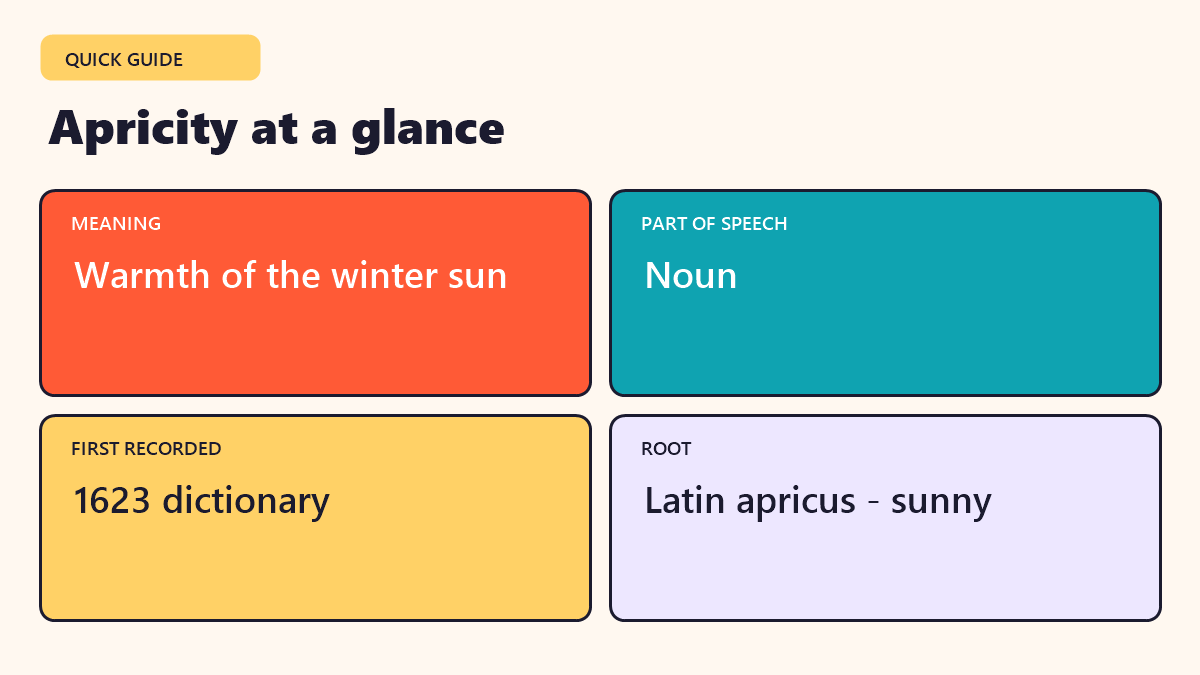
Apricity (said ah-PRIS-ih-tee) is a noun that means “the warmth of the sun in winter.” It does not describe all sunshine. It describes the special, gentle warmth you feel when the air is cold, but the sun is shining. It is a small word with a big feeling.
Where does apricity come from?
The word comes from the Latin apricus, which means “sunny” or “open to the sun.” It appeared in print in 1623, in an English dictionary by Henry Cockeram, which defined it as the warmth of the sun in winter. After that, it almost disappeared from use. Over the last few years, it has become popular again among people who love rare and beautiful words.
Why does apricity feel special?
A cold day can make people feel tired or low. A moment of winter sunlight stands out because it is rare and soft. Many people find that stepping outside, even for a short time, lifts their mood. Apricity captures that small relief in one word, which is part of why writers like it.
How to use apricity in a sentence
- “I stood by the window and soaked up the apricity of a January morning.”
- “The apricity on the porch made the cold air bearable.”
- “She closed her eyes and let the apricity warm her face.”
- “After the long storm, a thin line of apricity broke through the clouds.”
The word fits best in descriptive writing. It paints a picture in a single word.
When to use it
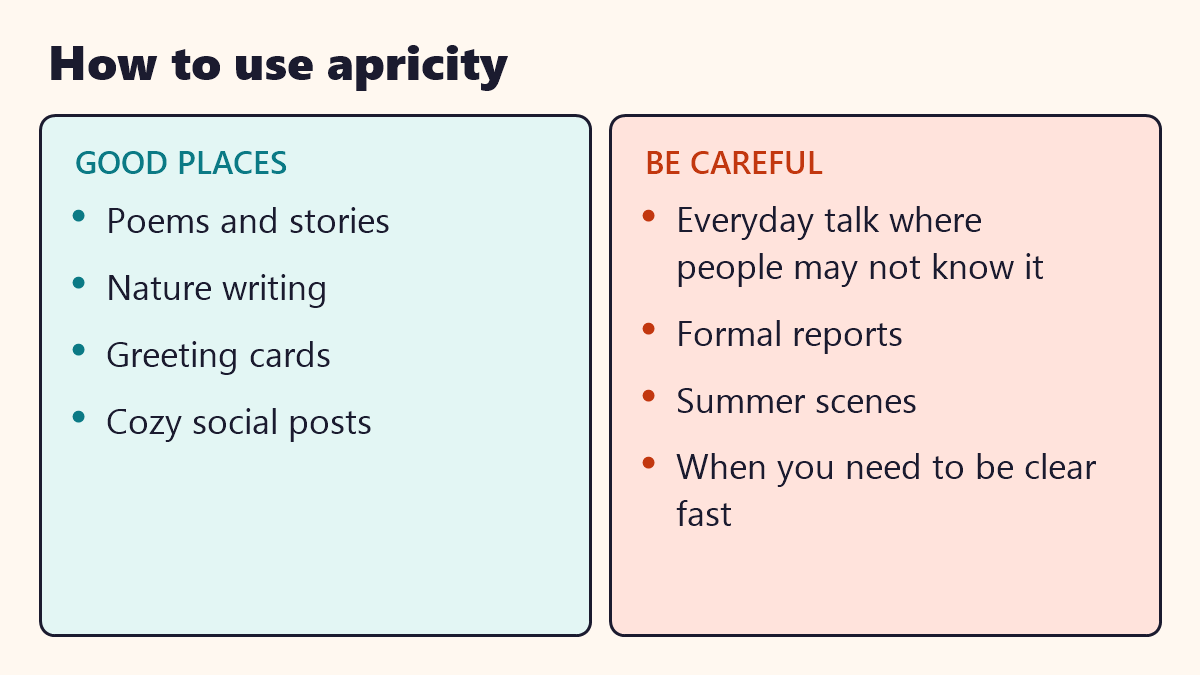
If you use apricity in everyday talk, many people will not know it. That can be fun, because it starts a conversation. When you need to be sure that everyone understands, add a short note, as in “apricity, the warmth of the winter sun.”
Words that feel similar to apricity
| Word | Meaning | Feeling |
|---|---|---|
| Apricity | Warmth of winter sun | Soft, rare comfort |
| Petrichor | The smell of rain on dry earth | Fresh, earthy |
| Sunbeam | A ray of sunlight | Bright, simple |
| Hygge | A Danish idea of cozy contentment | Warm, homey |
| Solace | Comfort in sadness | Gentle, caring |
| Halcyon | Calm and peaceful | Peaceful, nostalgic |
These words belong to the family of “beautiful words,” and each one catches a mood that ordinary words miss. Petrichor, for example, was created in 1964 by two Australian scientists to describe the earthy smell after rain.
Why rare words are worth learning
Learning rare words does not mean you have to use them every day. They give you more colors to paint with when you write. A person who knows “apricity” can describe a winter morning with more care. They also teach us how language changes. Some words fade for centuries and then come back when people find a use for them again.
Tips for using rare words
- Use one rare word at a time.
- Make sure the meaning fits your sentence.
- Check the spelling and pronunciation before using it.
- Add a little context so readers can guess the meaning.
- Do not force a rare word where a simple one would be clearer.
Common mistakes
- Using apricity for summer heat. It is specific to winter.
- Mispronouncing it. The stress is on the second syllable.
- Confusing it with “apricot.” Both come from related roots, but they mean different things.
- Treating it as a common word. Most readers will not know it.
Key takeaways
- Apricity means the warmth of the sun in winter.
- It comes from Latin apricus and appeared in a 1623 dictionary.
- It is rare, so use it in writing and add a hint when needed.
- It belongs to a group of beautiful words like petrichor and hygge.
- Knowing such words enriches your writing.
Frequently asked questions
What does apricity mean?
Apricity means the warmth of the sun in winter.
How do you pronounce apricity?
It is said ah-PRIS-ih-tee, with the stress on the second syllable.
Is apricity a real word?
Yes. It appears in an English dictionary from 1623, though it is very rare today.
Where does apricity come from?
It comes from the Latin word apricus, which means “sunny” or “exposed to the sun.”
What is a similar word to apricity?
There is no exact synonym, but “sunbeam,” “warmth” and “winter sunshine” are close ideas.