
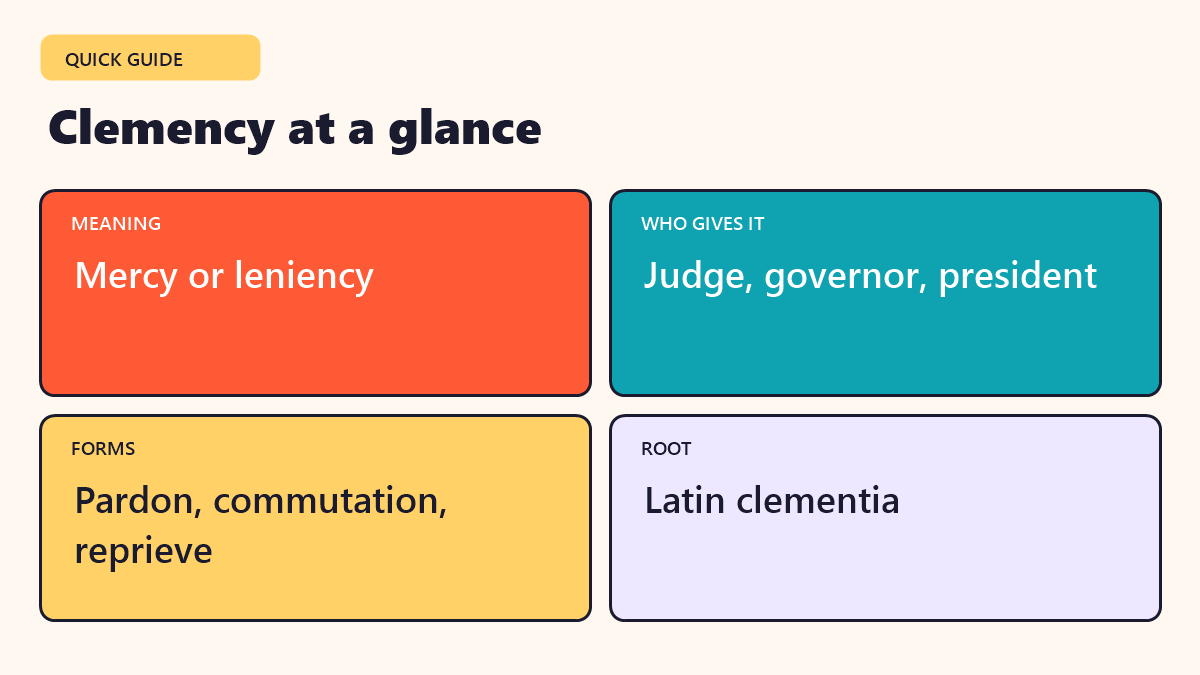
Quick answer: Clemency means mercy or leniency, especially when someone in authority, like a judge, governor or president, chooses to reduce or cancel a punishment. It can also describe mild, gentle weather.
Featured image: Photo by Tingey Injury Law Firm on Unsplash
You may hear the word clemency in the news when someone asks a governor to spare a prisoner, or in a movie when a king shows mercy to an enemy. It is a serious word with a gentle meaning. This guide explains what clemency is, how it works in real life and how to use the word in your own writing.
In this guide
What does clemency mean?
Clemency means mercy or leniency. It describes the act of showing kindness instead of strict punishment, especially when someone with power has the right to choose. A judge may show clemency by giving a lighter sentence, and a president or governor may grant it by reducing or canceling a sentence.
The word also has a quiet second meaning: mild, calm weather. A “clement day” is a pleasant day.
Where does clemency come from?
Clemency comes from the Latin word clementia, which means mildness, gentleness or mercy. The same root gave us the adjective clement (merciful or mild) and its opposite, inclement, as in “inclement weather.” It also gave the name Clement, which means “merciful.”
Forms of clemency in law
| Form | What it means | Example |
|---|---|---|
| Pardon | Forgives a crime and removes punishment | A governor pardons a person after many years |
| Commutation | Reduces the punishment but does not erase the crime | A long sentence is shortened |
| Reprieve | Delays a punishment for a time | An order is paused while the case is reviewed |
| Amnesty | A general pardon for a group | Used after conflicts or for certain offenses |
| Remission | Reduces part of a sentence | Often for good behavior |
Rules differ from country to country and from state to state. In the United States, the president can grant clemency for federal crimes, and governors can do so for state crimes in many states. In other countries, a head of state or special board may have the power.
Clemency in everyday language
- “The defense lawyer asked the judge for clemency because of the young man’s age.”
- “The governor showed clemency and reduced the sentence.”
- “The king granted clemency to the soldiers who surrendered.”
- “A plea for clemency was sent to the president.”
Notice that someone with power gives clemency, and someone without power usually asks for it.
How clemency differs from similar words
| Word | Meaning | Difference from clemency |
|---|---|---|
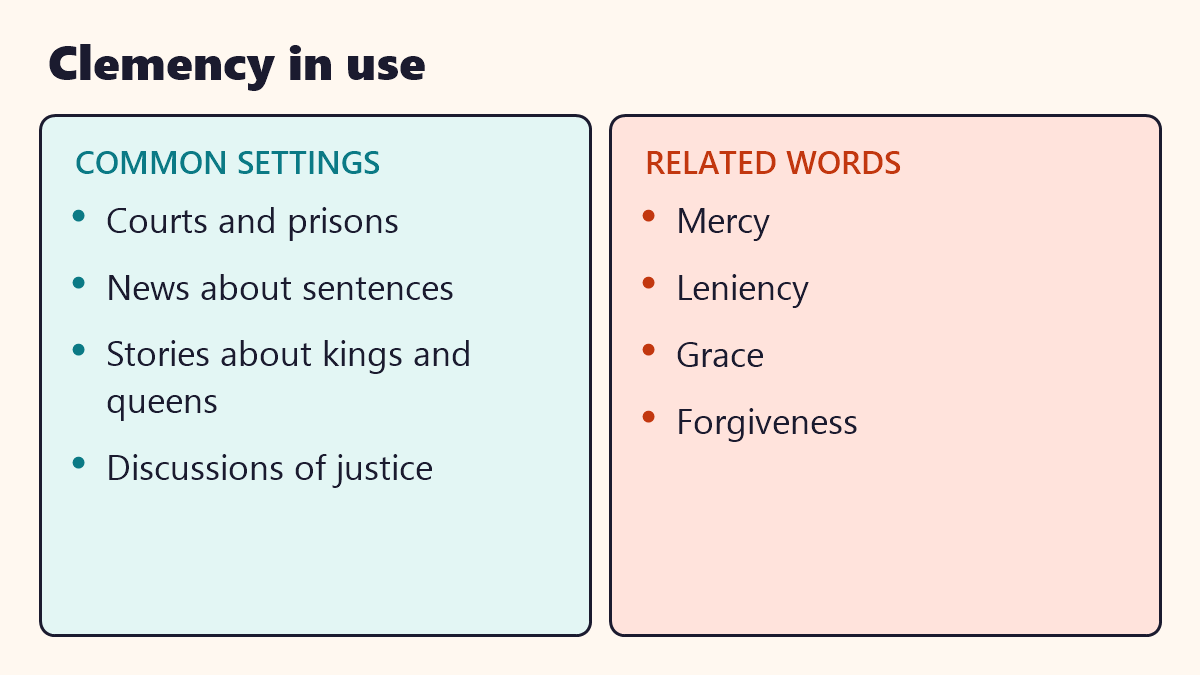
| Mercy | Kindness toward someone who could be punished | A broader, more general word |
| Leniency | Being less strict than usual | Often about rules and sentences |
| Forgiveness | Letting go of anger | Personal and emotional |
| Grace | Undeserved kindness | Often religious or moral |
| Pardon | An official forgiveness of a crime | A type of clemency |
In short, clemency is the official, powerful kind of mercy.
Clement and inclement
These two words are linked to the same idea. Clement describes mild or merciful conditions: “a clement spring day.” Inclement describes harsh or stormy conditions: “The game was cancelled because of inclement weather.” You will often see “inclement” and almost never “clement,” but they are a matched pair.
Why clemency matters
Societies use clemency as a safety valve in the justice system. It lets leaders correct unfair sentences, recognize change in a person’s life or respond to new facts. Supporters see it as a sign of a humane system. Critics worry that it can be used in unfair or political ways. Because of this, clemency is often debated in public.
Tips for using clemency in writing
- Use it when someone with power chooses to be lenient.
- Pair it with verbs like “grant,” “show,” “seek,” or “plead for.”
- Use “mercy” in everyday talk, where “clemency” might sound too formal.
- Keep the legal terms straight, as a pardon and a commutation are different.
- Avoid using it for simple kindness between friends.
Common mistakes
- Using it for any kind act. It suggests power and punishment.
- Confusing it with “pardon.” A pardon is only one kind.
- Forgetting “clement” is also a word. It describes mild weather.
- Misspelling it as “clemancy.” The correct spelling ends in “-ency.”
Key takeaways
- Clemency means mercy or leniency from someone in authority.
- It includes pardons, commutations, reprieves and more.
- It comes from Latin clementia.
- “Clement” and “inclement” describe mild or harsh weather.
- Use “mercy” in daily talk and “clemency” in formal or legal settings.
Frequently asked questions
What does clemency mean?
Clemency means mercy or leniency, especially when an authority lowers or cancels a punishment.
Is clemency the same as a pardon?
A pardon is one kind of clemency. Clemency is the broader idea and also includes commutation and reprieve.
What is executive clemency?
It is clemency granted by the head of the executive branch, such as a president or governor.
What is the opposite of clemency?
Harshness, severity or cruelty.
What does clement mean?
Clement describes mild, pleasant weather or a merciful person. Its opposite, inclement, means stormy or harsh.