
Quick answer: Dale literally means “give it to him or her” in Spanish. In everyday talk it often means “okay,” “go ahead” or “let us go.” It is common in Latin American Spanish, especially in the Caribbean and Argentina.
Featured image: Photo by Vitaly Gariev on Unsplash
You hear a friend say “dale!” in a Spanish conversation, and everyone smiles and moves on. What does it mean? The word is short, friendly and used every day by millions of people. This guide explains the literal meaning, the everyday meaning and the best ways to use dale.
In this guide
What does dale mean?
Dale comes from the verb dar (“to give”) plus the small word le (“him,” “her” or “it”). Literally, it means “give it to him” or “give it to her.” You might use it that way when you tell someone to hit a ball, press a button or give a gift: “Dale al botón” means “press the button.”
In daily talk, though, dale has become an all-purpose word of agreement and encouragement.
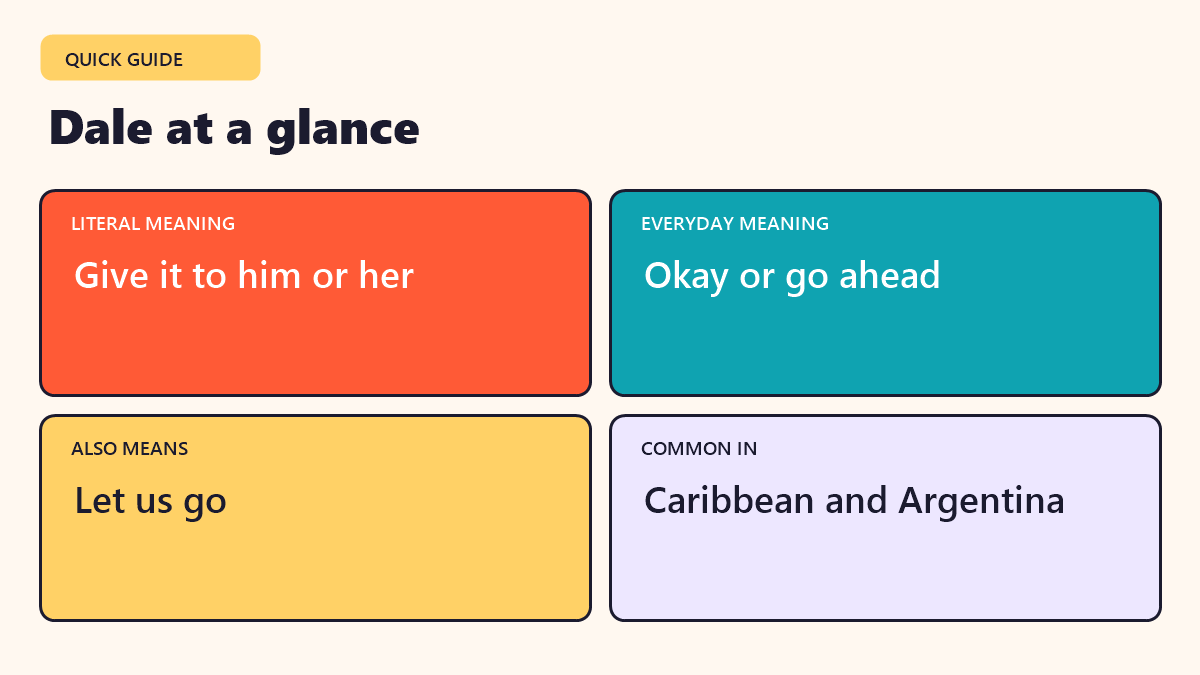
The everyday meanings of dale
- Okay or agreed. “Nos vemos a las cinco.” “Dale.” (See you at five. Okay.)
- Go ahead. “Dale, empieza.” (Go ahead, start.)
- Come on, let us go. “Dale, que llegamos tarde.” (Come on, we will be late.)
- Keep going, you can do it. “Dale, dale, dale.” (Go, go, go.)
- Goodbye, friendly. “Dale, hablamos luego.” (Okay, talk later.)
The exact feeling depends on tone. A quick, light “dale” is agreement. A loud, repeated “dale, dale” is a cheer.
Examples in real conversations
Amigo: ¿Nos vemos mañana?
Tú: Dale, a las seis.
Amigo: ¿Empiezo?
Tú: Dale, te escucho.
Madre: Hay que irnos ya.
Hija: Dale, ya voy.
In each case “dale” works like “okay” in English, but with more warmth and energy.
Where is dale used?
The word is widespread across Latin America. It is especially common in the Caribbean, Argentina and Uruguay, and many speakers in Mexico and Central America use it too. In Spain, “vale” is the usual word for “okay,” so “dale” sounds a bit foreign there, though people understand it.
Dale vs other ways to say okay
| Word | Where common | Feeling |
|---|---|---|
| Dale | Latin America, Caribbean, Argentina | Friendly, energetic |
| Vale | Spain | Neutral, friendly |
| Listo | Latin America | Ready, done |
| Claro | Everywhere | Of course |
| Está bien | Everywhere | It is fine |
| De acuerdo | Everywhere | Formal agreement |
If you travel in Latin America, “dale” will make you sound relaxed and friendly. In Spain, “vale” is the safer choice.
How to use dale
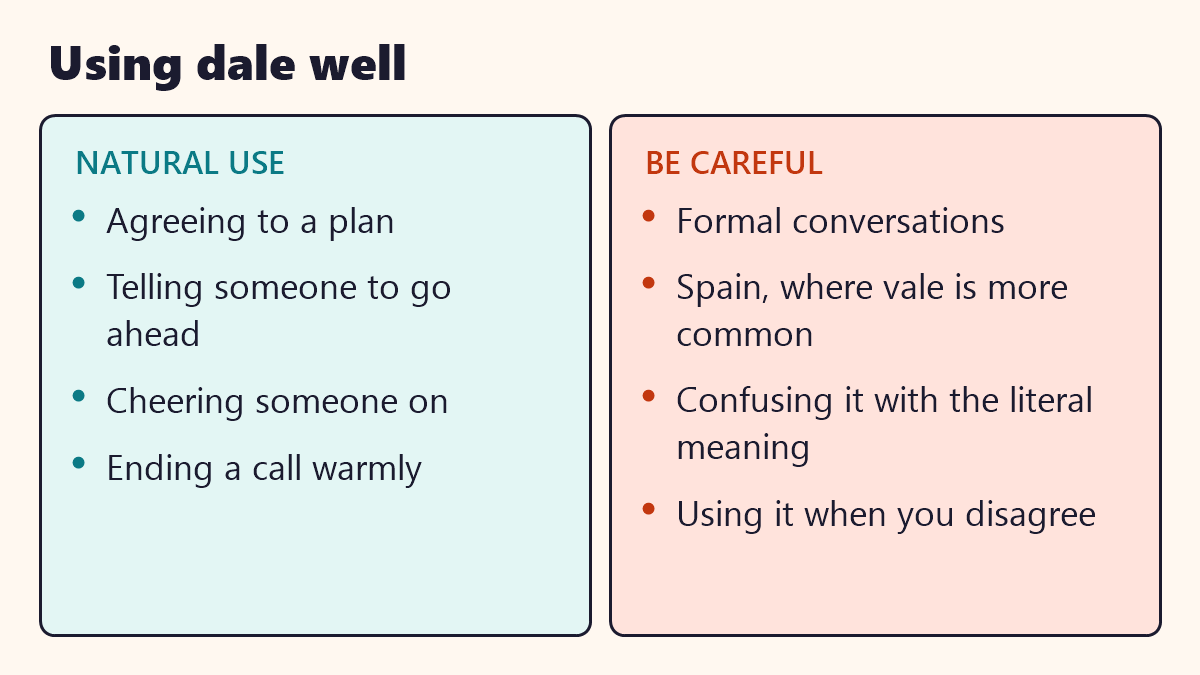
A good habit is to listen first. Notice how people around you answer a question or agree to a plan, and copy their style.
Fun phrases with dale
- Dale gas: step on the gas, hurry up
- Dale que sí: come on, say yes
- Dale pues: okay then
- Dale con todo: go all in
- Dale un abrazo: give him or her a hug
Common mistakes with dale
- Reading it only literally. People are not asking you to give something away.
- Using it in formal emails. Choose “de acuerdo” there.
- Using it in Spain without a smile. “Vale” will feel more natural.
- Saying it when you disagree. Dale means yes or go ahead.
Key takeaways
- Dale literally means “give it to him or her.”
- In daily talk it means “okay,” “go ahead” or “let us go.”
- It is very common in the Caribbean, Argentina and much of Latin America.
- In Spain, people say “vale” more often.
- Use it with friends and family, not in formal writing.
Dale across generations and regions
Younger speakers in many Latin American countries use “dale” constantly in casual texting, almost as a default way to agree to anything. Older speakers tend to use it just as often, but sometimes reach for “bueno” or “está bien” in slightly more formal family conversations, while still keeping “dale” for quick, everyday replies.
Dale in music and pop culture
The word shows up constantly in Latin music, often repeated for rhythm and energy rather than literal meaning, as in a chorus shouting “dale, dale, dale!” This repeated, chant-like use is part of why the word feels so energetic and recognizable even to people who do not speak Spanish fluently.
Frequently asked questions
What does dale mean in Spanish?
Literally it means “give it to him or her.” In daily talk it often means “okay,” “go ahead,” “come on” or “let us go.”
Is dale a command?
Yes, grammatically it is a command form of “dar,” to give. People use it as an idiom for agreement or encouragement.
Where is dale used?
It is very common in the Caribbean, Argentina, Uruguay and many other Latin American places, and people understand it widely.
How do you say okay in Spanish like a native?
Many speakers say “dale,” “vale,” “listo” or “ok,” depending on the country.
Is dale slang?
It is informal and friendly. You can use it with friends and family, but choose a more formal word in serious or professional talk.