Quick answer: BOGO stands for “buy one, get one.” It is a sales offer where buying one item gets you a second item free or at a lower price. You will see it written as BOGO, BOGO Free or BOGO 50% Off, each meaning a slightly different deal.
Featured image: Photo by Tamanna Rumee on Unsplash
A sign in a store window reads “BOGO 50% Off,” and you want to know exactly what you are getting. This guide explains what BOGO means, the different types of BOGO deals and how to make sure you are actually saving money.
In this guide
What does BOGO mean?
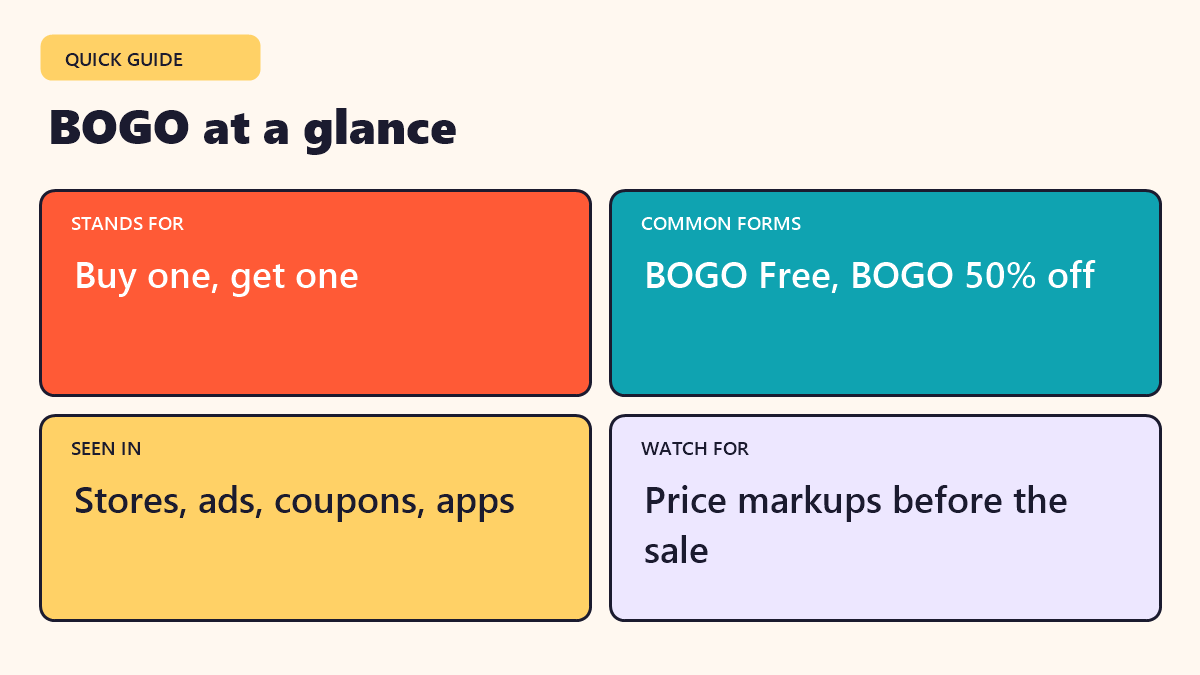
BOGO stands for “buy one, get one.” It describes a sales offer where purchasing one item earns you a second item for free or at a reduced price. You will see it on store signs, coupons, online ads and shopping apps, usually written in all capital letters to catch your eye.
Common types of BOGO deals
| Label | What it means |
|---|---|
| BOGO Free | Buy one item, get the second item completely free |
| BOGO 50% Off | Buy one item, get the second item at half price |
| BOGO 25% Off | Buy one item, get the second item at a smaller discount |
| B2G1 Free | Buy two items, get a third item free |
| BOGO (any item) | Mix and match: the free or discounted item can be different from the first |
The exact rules vary by store, so it is worth reading the fine print, especially for whether the discount applies to any item or only an identical one.
How BOGO deals usually work
- Pick your first item at its regular price.
- Add a second item, which may need to be the same product, a similar one, or any item depending on the store’s rules.
- The discount applies automatically at checkout, either in person or online, though some stores require a coupon code.
- Check the receipt or order summary to confirm the discount was applied correctly.
Shopper: Does this BOGO work on any flavor?
Store clerk: Yes, you can mix and match any flavor for the free one.
Where you will see BOGO
- Grocery stores, especially for snacks, drinks and household items.
- Clothing and shoe stores, often during seasonal sales.
- Pharmacies, for items like vitamins, skincare and over-the-counter medicine.
- Restaurants, for meals, drinks or desserts.
- Online shopping apps, often shown as a banner or applied automatically in your cart.
Is BOGO always a good deal?
Not always. Some retailers raise the regular price of an item just before launching a BOGO sale, so the “free” item is really already baked into a higher starting price. This practice is sometimes called a price markup before markdown.
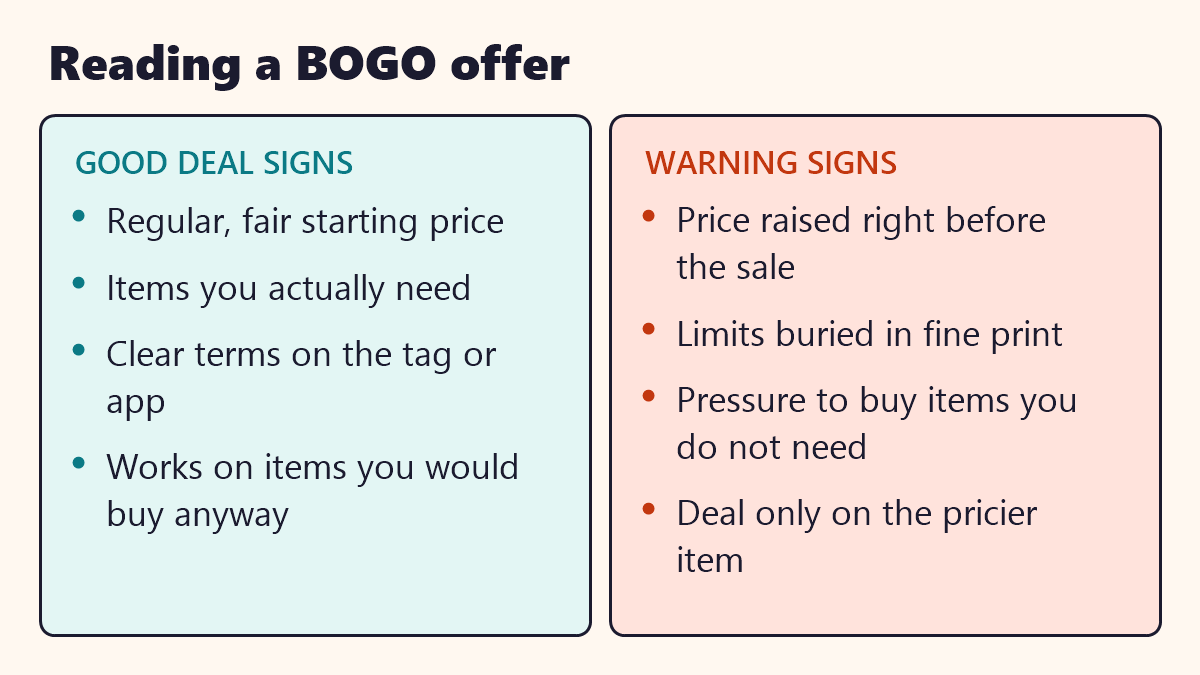
Before you buy, it helps to have a rough idea of the item’s usual price. A quick look at a price history tool, a past receipt or a nearby competitor can tell you whether the BOGO deal is a genuine saving.
Tips for making the most of BOGO deals
- Only buy items you actually planned to use, not just because the deal looks good.
- Compare the BOGO price per item with the regular price per item elsewhere.
- Check expiration dates on BOGO food and medicine, since stores sometimes run these deals to clear older stock.
- Read whether the deal requires identical items or allows a mix and match.
- Watch for a limit on how many BOGO deals you can use in one visit.
BOGO and similar sales terms
| Term | Meaning |
|---|---|
| BOGO | Buy one, get one |
| B1G1 | Same as BOGO, just written differently |
| Clearance | Items marked down to clear out stock |
| Flash sale | A short, limited-time discount |
| Loss leader | An item priced low to draw in shoppers, even at a loss |
Common mistakes with BOGO
- Buying things you do not need just for the deal. A “bargain” is not a bargain if it is unused.
- Not checking if the price was raised beforehand. Some deals are not as generous as they look.
- Assuming it is always two identical items. Many stores allow a mix and match.
- Ignoring the expiration date on BOGO food or medicine.
Key takeaways
- BOGO means “buy one, get one,” a common sales offer.
- BOGO Free means the second item is free, while other versions give a partial discount.
- Rules vary by store, so check whether items must match.
- Some BOGO prices are inflated beforehand, so compare prices to be sure.
- Buy only what you would normally need, even with a good deal.
Why retailers like BOGO over a flat discount
A BOGO deal often moves more total inventory than an equivalent percentage discount, since it pushes shoppers to buy two items instead of one. For stores clearing seasonal stock or overstocked items, this makes BOGO a popular tool even when the actual dollar discount works out similar to a simpler sale.
A quick math check before you buy
To judge a BOGO deal fairly, divide the combined price of both items by two and compare that per-item price to the regular shelf price elsewhere. This quick calculation cuts through marketing language and shows the real discount you are actually getting.
Frequently asked questions
What does BOGO mean?
BOGO stands for “buy one, get one,” a sales offer where a second item is free or discounted when you buy the first.
Is BOGO always free?
Not always. “BOGO Free” means the second item is free, but offers like “BOGO 50% Off” only lower the price of the second item.
Do I have to buy the same item twice for BOGO?
It depends on the store. Some BOGO deals require identical items, while others let you choose any item of equal or lesser value for the second item.
Is BOGO always a good deal?
Not always. Some stores raise the regular price before running a BOGO sale, so it helps to check if the price is genuinely good before you buy.
Can BOGO apply to services, not just products?
Yes. Some gyms, restaurants and salons offer BOGO deals on services, such as a free class or a discounted second meal.