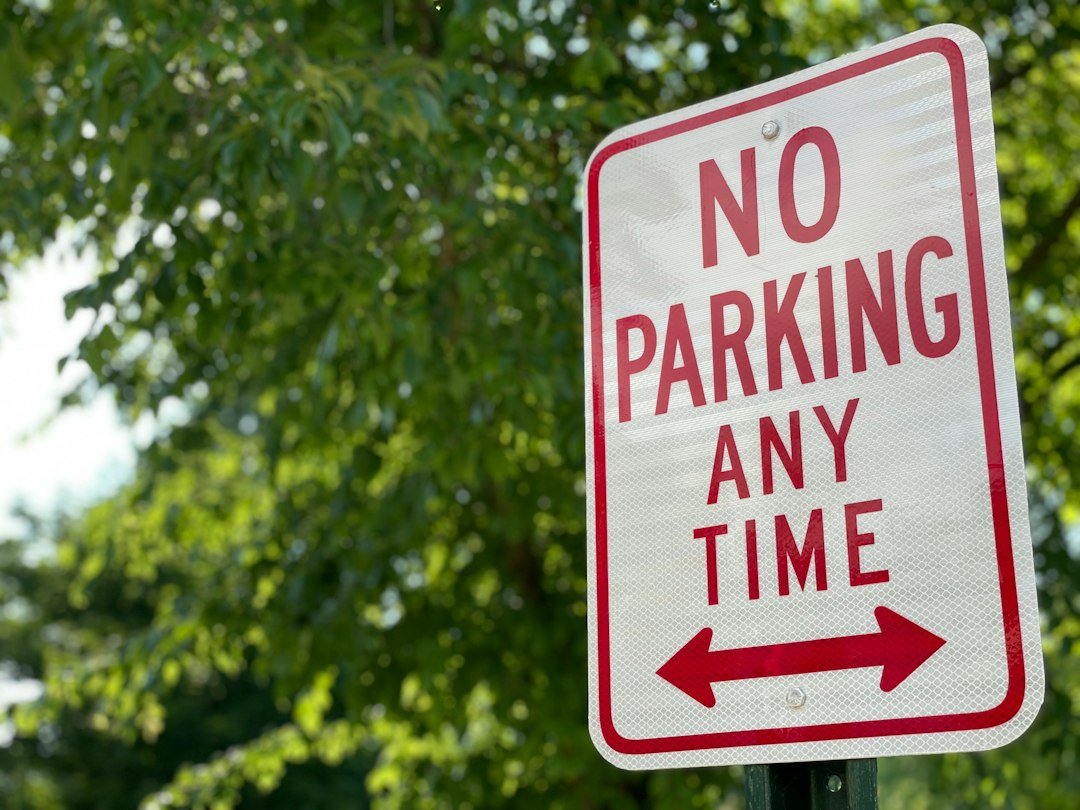
Quick answer: Permitted means allowed or given permission. It is the past form of the verb “permit.” A sign that says “Parking permitted” tells you that you are allowed to park there.
Featured image: Photo by Steve DiMatteo on Unsplash
You see the word on a sign, in a contract or in a school rulebook: permitted. It looks simple, yet many learners wonder how to use it correctly. This guide explains what permitted means, shows how the verb works and gives clear examples you can copy.
In this guide
What does permitted mean?
Permitted means “allowed” or “given permission.” It can describe something that rules, laws or people say you may do. For example, “Pets are permitted in this park” means you are allowed to bring pets.
The word is the past tense and the past participle of the verb permit, and it can also work as an adjective.

The verb “permit” and its forms
| Form | Spelling | Example |
|---|---|---|
| Base | permit | They permit dogs on the beach. |
| Third person | permits | The school permits phones at lunch. |
| Past | permitted | The teacher permitted us to leave early. |
| Past participle | permitted | We were permitted to enter. |
| Present participle | permitting | Permitting them to speak was fair. |
Notice that the final “t” doubles before “-ed” and “-ing.” That happens because the stress falls on the last syllable: per-MIT.
Pronunciation: noun vs verb
- As a verb, say per-MIT, with the stress on the second syllable.
- As a noun, say PER-mit, with the stress on the first.
- The adjective permitted is said per-MIT-id.
As a noun, a “permit” is an official document, such as a work permit or a building permit.
How to use permitted in sentences
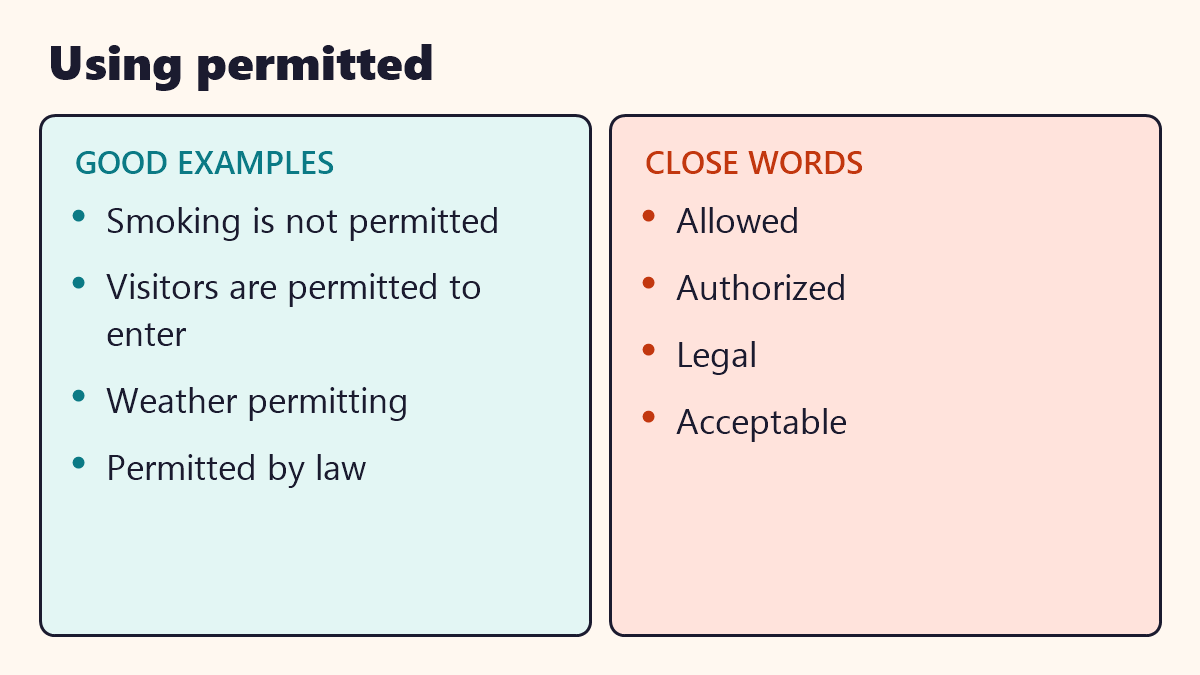
- “Visitors are permitted to take photos in the garden.”
- “Smoking is not permitted in this building.”
- “Weather permitting, we will have the picnic outside.”
- “The law permitted the company to use the land.”
- “Only small bags are permitted on the plane.”
Many of these sentences use the passive form: “are permitted,” “is not permitted.” That is very common in rules and signs.
Common patterns
| Pattern | Example |
|---|---|
| Be permitted to + verb | Students are permitted to use calculators. |
| Permitted by + law or rule | The activity is permitted by law. |
| Not permitted | Food is not permitted in the lab. |
| Weather permitting | We will start at noon, weather permitting. |
| Permit someone to + verb | The manager permitted her to leave. |
“Weather permitting” is a short, polite phrase that means “if the weather allows.”
Permitted and similar words
| Word | Meaning | Tone |
|---|---|---|
| Permitted | Allowed | Neutral, common in rules |
| Allowed | Let or made possible | Simple and everyday |
| Authorized | Officially approved | Formal |
| Permissible | Acceptable under the rules | Formal |
| Legal | Allowed by law | Specific to law |
| Licensed | Officially approved with a license | For trades and driving |
For everyday talk, “allowed” is usually the easiest choice. In signs, laws and policies, “permitted” sounds more formal.
Opposites of permitted
- Prohibited: officially forbidden
- Forbidden: not allowed, with a strong feeling
- Banned: forbidden by a rule or authority
- Not allowed: the simple everyday opposite
Why this word shows up so often
Rules are everywhere: in schools, on roads, in workplaces and in apps. Almost every rule says what is “permitted” and what is not. Understanding the word helps you read signs, contracts and terms of use with confidence. When you see “permitted uses” in a document, it tells you exactly what you are allowed to do.
Tips for using permitted well
- Use “permitted” in rules and formal writing.
- Use “allowed” in daily conversation.
- Remember to double the “t” when you add “-ed” or “-ing.”
- Pair it with “to” and a verb: “permitted to enter.”
- Check the stress: per-MIT for the verb.
Common mistakes
- Writing “permited.” The correct spelling has two t’s.
- Mixing up the noun and verb stress. Noun: PER-mit. Verb: per-MIT.
- Using “permitted” for a person’s ability. Use “able” or “can” instead.
- Using it for kindness. “Permitted” is about rules and permission.
Key takeaways
- Permitted means allowed or given permission.
- It is the past form of “permit.”
- Double the “t” in “permitted” and “permitting.”
- “Permit” can be a verb or a noun, with different stress.
- Use “allowed” in everyday talk and “permitted” in rules.
Permitted in legal and policy documents
In contracts, terms of service, and official rules, “permitted” carries real weight. A section titled “Permitted Uses” is usually meant to be read as an exhaustive list, meaning anything not mentioned may be assumed to fall outside what is allowed, which is why careful readers pay close attention to this specific word in legal text.
A quick contrast in tone
| Sentence | Feel |
|---|---|
| “Phones are permitted during the break.” | Neutral, rule-based |
| “Phones are allowed during the break.” | Casual, friendly |
| “Phones may be used during the break.” | Formal, polite |
Frequently asked questions
What does permitted mean?
Permitted means allowed or given official or general permission.
What is the difference between permit and permitted?
“Permit” is the base verb, and “permitted” is its past tense and past participle. “Permit” can also be a noun, meaning an official document.
Is permitted the same as permissible?
They are close. “Permissible” describes what is allowed by rules. “Permitted” often describes what has been allowed.
What is the opposite of permitted?
Forbidden, prohibited, banned or not allowed.
How do you pronounce permitted?
It is said per-MIT-id, with the stress on the second syllable.