
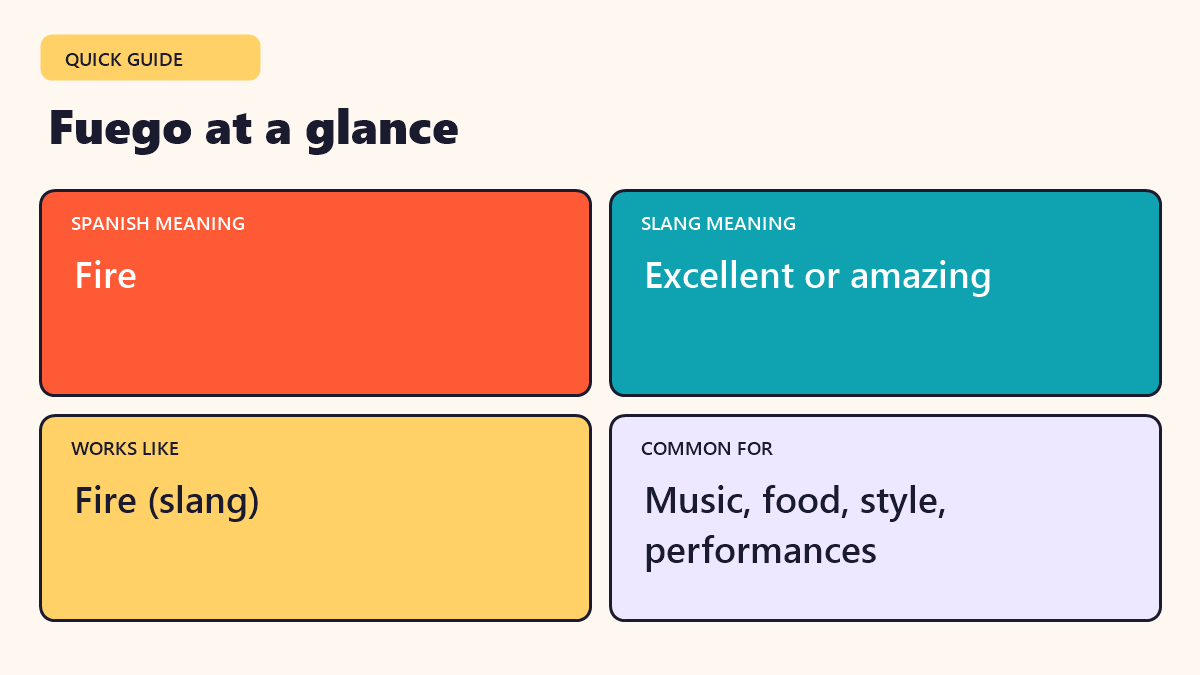
Quick answer: Fuego is the Spanish word for fire. In English slang, calling something “fuego” means it is excellent, impressive or amazing, the same way people say something is “fire.” It is a high-energy compliment used for music, food, outfits and more.
Featured image: Photo by Nainoa Shizuru on Unsplash
A comment under a song or a photo simply says “fuego 🔥,” and you want to know exactly what that means. This guide explains the word, where the slang use comes from and how to use it naturally in an English sentence.
In this guide
What does fuego mean?
Fuego is the Spanish word for fire. In slang, especially mixed into English sentences, calling something “fuego” means it is excellent, impressive or amazing. It works exactly like the English slang word “fire,” as in “this song is fire.”
You will usually see it paired with a fire emoji, 🔥, which reinforces the same idea without needing extra words.
Where does the slang use of fuego come from?
Spanish and English have mixed in music and online culture for a long time, especially through reggaeton, Latin trap and pop music that blend both languages. Artists and fans began using “fuego” the same way English speakers use “fire,” as a short way to say something is excellent. Social media captions and comments carried the word further, and now it shows up in English sentences from people who may not otherwise use much Spanish at all.
How people use fuego
Describing music
Friend: Have you heard the new single?
You: Yeah, that track is fuego.
Describing food
Friend: How was the taco truck?
You: Honestly fuego, best tacos I have had in months.
Describing an outfit
Friend: New jacket?
You: Yep.
Friend: That is fuego.
Describing an event or performance
You: The concert last night was absolute fuego.
Friend: I am so jealous.
In each case, “fuego” sits in for words like “amazing,” “incredible” or “the best,” and it adds a bit of energy and style to the sentence.
Fuego and similar slang
| Word | Meaning | Language origin |
|---|---|---|
| Fuego | Excellent, amazing | Spanish for fire |
| Fire (slang) | Excellent, amazing | English |
| Lit | Exciting, excellent | English |
| Slaps | Sounds really good (often music) | English |
| Straight fire | Very impressive | English, stronger version |
These words are close cousins. “Fuego” simply brings the same idea with a Spanish flavor, which many people enjoy for its sound and energy.
When fuego fits, and when to skip it
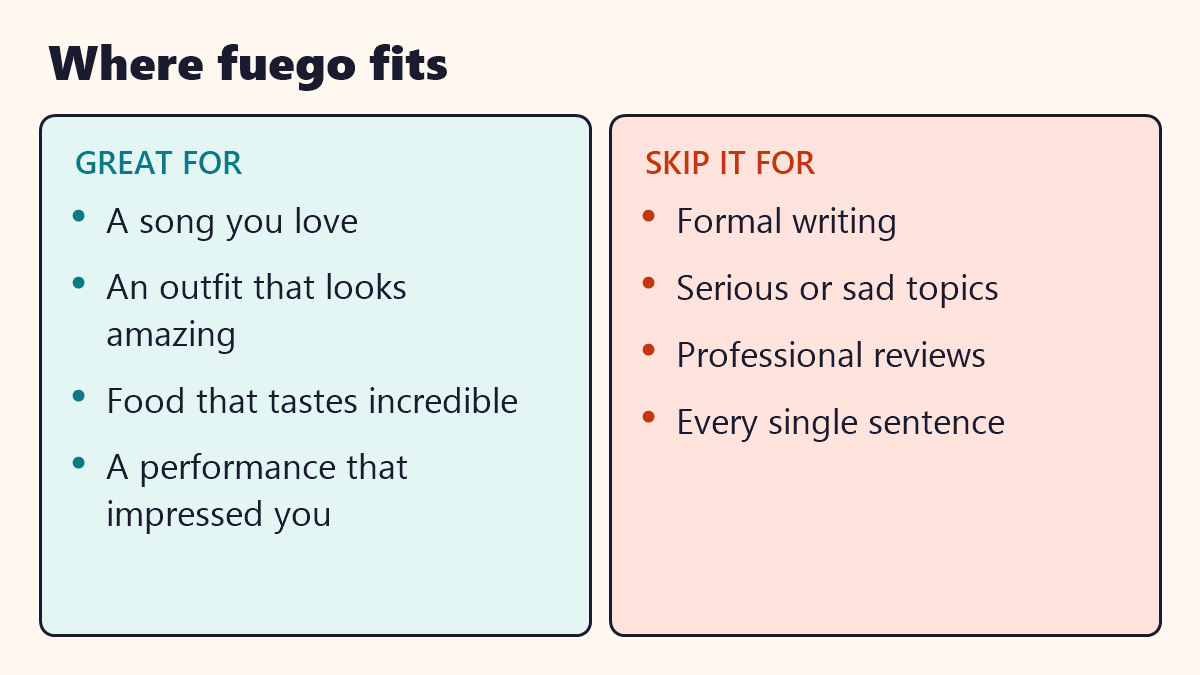
As with most slang, think about your audience. A caption, a text to a friend or a comment on a video is a great place for “fuego.” A cover letter or a school essay is not.
Fuego as a name and in other contexts
Outside of slang, “fuego” appears in many other places: as a nickname, in brand names, in song and album titles, and in Spanish phrases about fire itself, such as “apagar el fuego” (to put out the fire) or “jugar con fuego” (to play with fire, meaning to take a risk). Context will usually make clear whether someone means literal fire or the slang compliment.
Common mistakes
- Using it in formal writing. It is casual slang, not suited to professional reviews or essays.
- Using it for sad or serious topics. The word carries high, positive energy, so it does not fit somber moments.
- Overusing it. Like any slang, repeating it constantly makes it lose its punch.
- Forgetting the emoji pairing. Many people expect to see 🔥 alongside the word, so it can read oddly without any visual cue in text form.
Tips for using fuego naturally
- Use it to praise music, food, fashion or events.
- Pair it with the fire emoji if you are texting or posting.
- Keep it to casual chats, captions and comments.
- Mix it with other slang like “no cap” or “straight fire” for variety.
- Save plain, clear language for formal or professional writing.
Key takeaways
- Fuego is Spanish for fire.
- As slang, it means something is excellent, impressive or amazing.
- It grew popular through Spanish-English music and social media.
- It fits casual chats, captions and comments well.
- Skip it in formal or serious writing.
Fuego beyond Spanish-English blending
While fuego is rooted in Spanish, its slang use today spreads mostly through English-language captions, independent of whether the poster speaks Spanish at all. This is common with loanwords in internet slang: a word borrowed for its sound and energy, used by people who may know only that one word in the language it came from.
Fuego vs. its closest English equivalent
“That’s fire” and “that’s fuego” are close to perfectly interchangeable in casual use today. The main difference is tone: fuego often feels slightly more playful or stylized, in part because it stands out from fully English sentences, drawing a bit more attention to the compliment.
Frequently asked questions
What does fuego mean?
Fuego is Spanish for fire. In English slang, it means something is excellent, impressive or amazing.
Is fuego the same as saying something is fire?
Yes, they mean the same thing. “Fuego” is simply the Spanish word used the same way English speakers use “fire” as slang.
Where does the slang use of fuego come from?
It grew out of Spanish-English blending in music, especially reggaeton and Latin trap, and spread through social media captions and comments.
Can fuego describe a person?
Yes, people sometimes use it to say someone looks amazing or has a lot of energy, similar to calling someone “fire.”
Is fuego appropriate for any audience?
It is informal, so it fits casual captions and chats well but is not suited to formal or professional writing.