
Quick answer: SMH stands for “shaking my head.” You type it when something disappoints, annoys or amazes you in a negative way, as if you were slowly shaking your head. It can sound funny among friends and rude if aimed at someone.
Featured image: Photo by Afif Ramdhasuma on Unsplash
Someone replies to your message with “smh.” You are not sure if it is a joke or a criticism. That is normal, because SMH has a tone you can only judge by context. This guide explains what SMH means and how to read it, use it and answer it.
In this guide
- What does SMH mean?
- Where does SMH come from?
- How people use SMH
- SMH, SMDH and SMFH
- When SMH helps, and when it hurts
- How to reply to SMH
- SMH on social media
- How different people read SMH
- Better ways to show disappointment
- Good and bad examples of SMH
- Common mistakes with SMH
- Tips for using SMH well
- Key takeaways
What does SMH mean?
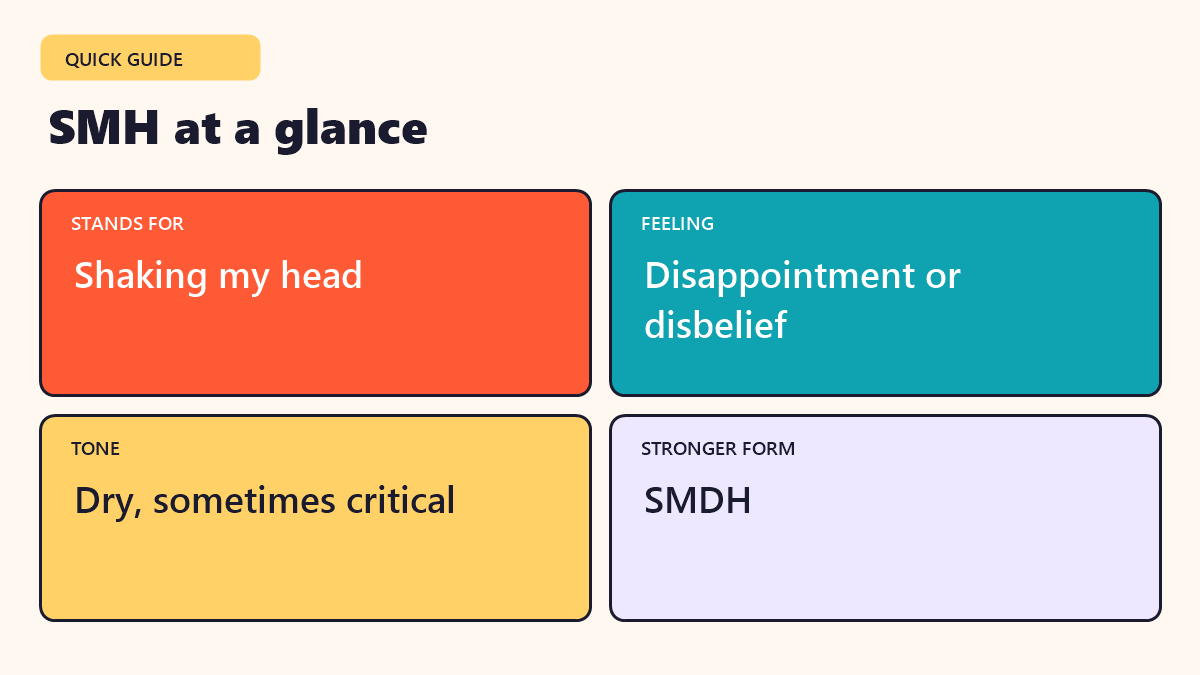
SMH is short for “shaking my head.” It copies the gesture of slowly turning your head from side to side. In real life, that move means “no” or “I cannot believe this.” Online, SMH does the same job, adding a mood of disappointment or disbelief.
The same letters can feel different depending on the reader. To a close friend, “smh” after you drop your snack feels like a laugh. To a stranger who disagrees with your opinion, it can feel like an eye-roll.
Where does SMH come from?
People started using SMH in chat rooms and early social sites, and it grew with Twitter and text messaging in the 2000s and 2010s. Because it is quick to type and easy to read, it stayed popular even as newer slang came and went. Today you will see it in comments, group chats and news headlines on social media.
How people use SMH
Reacting to a situation
Friend: I locked my keys in the car again.
You: smh, classic you.
Reacting to a news story
Friend: They canceled the show after one season.
You: smh, that is so unfair.
Joking about yourself
You: I walked into the wrong class. Smh.
Friend: Haha, it happens!
In all three examples the tone is light. SMH is often self-aware humor, a way to say “I cannot believe it, but I find it funny too.”
SMH, SMDH and SMFH
| Short form | Meaning | Strength |
|---|---|---|
| SMH | Shaking my head | Mild |
| SMDH | Shaking my damn head | Stronger |
| SMFH | Shaking my f***ing head | Strongest, uses strong language |
| FML | F*** my life | Frustration about your own luck |
| IJBOL | I just burst out laughing | Opposite mood |
The more letters you add, the stronger the feeling. Be careful with SMFH, because it contains a swear word.
When SMH helps, and when it hurts
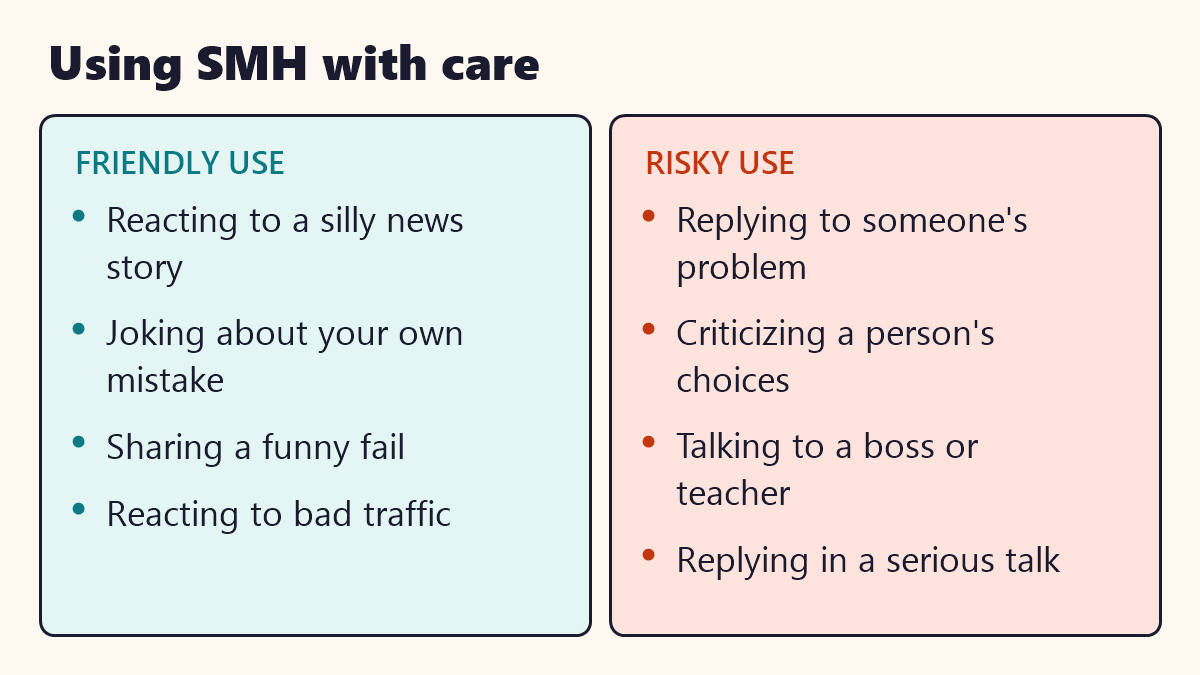
A good test is to imagine saying the words out loud to the person. If you would roll your eyes in their face, it may be better not to send it.
How to reply to SMH
- When it is about a situation: “I know, right?”
- When it is about you: “Okay, what did I do?”
- When it is funny: “Ha, I deserved that.”
- When it feels unkind: “That felt harsh. Can we talk about it?”
SMH on social media
SMH is everywhere in comment sections. People use it under news stories, sports clips and celebrity posts. In those places it usually shows a shared reaction: “we all saw that, and we all cannot believe it.” When many users add it to the same post, it works like a group sigh.
Comment 1: They fumbled the ball in the last second.
Comment 2: smh, I cannot watch.
How different people read SMH
Not everyone reads SMH the same way. Younger users often treat it as a light, almost playful reaction. Some older users read it more literally, as a clear sign of disapproval. If you are texting a family member who does not use much slang, a plain sentence like “That was disappointing” may land better.
Better ways to show disappointment
- “I cannot believe that happened.”
- “That is such a shame.”
- “Well, that did not go as planned.”
- “Oh no, not again.”
- “That is disappointing, but we will handle it.”
These phrases show the same feeling with more warmth. They also work in school and work messages, where SMH would look out of place.
Good and bad examples of SMH
| Message | Verdict | Why |
|---|---|---|
| “smh, the train was late again” | Fine | It is aimed at a situation |
| “smh, you never listen” | Risky | It is aimed at a person |
| “I locked myself out. smh” | Fine | You are joking about yourself |
| “smh, that is your answer?” | Risky | It sounds like an eye-roll |
Common mistakes with SMH
- Using it when someone is sad. If a friend shares a problem, “smh” feels unfeeling.
- Using it to put someone down. It can come across as mean or superior.
- Overusing it. If every message says SMH, people may stop listening.
- Using it with strangers online. It tends to start arguments, not end them.
Tips for using SMH well
- Aim it at situations, not people.
- Pair it with humor or a laughing emoji when you are joking.
- Use it with friends who share your humor.
- Skip it in work and school messages.
- If you feel annoyed, take a breath before you send anything.
Key takeaways
- SMH means “shaking my head.”
- It shows disappointment or disbelief, and the tone depends on context.
- SMDH and SMFH are stronger versions.
- It is best used about situations, not people.
- Skip it when someone is hurt or upset.
Frequently asked questions
What does SMH mean in text?
SMH means “shaking my head.” It shows disappointment or disbelief.
What is SMDH?
SMDH adds a strong word and means “shaking my damn head.” It shows stronger frustration. Some people use “smfh” with a stronger word still.
Is SMH rude?
It can be. Used about a situation, it is fine. Used about a person’s words or choices, it can feel judging.
How do I reply to SMH?
Match the mood: agree, explain or joke. If it was aimed at you, you can ask, “What do you mean?”
When did SMH become popular?
It spread widely on social media and texting in the 2000s and 2010s and is still used today.