
Quick answer: Vicariously means experiencing something through another person instead of doing it yourself. If you enjoy a friend’s trip by watching their photos and stories, you are enjoying it vicariously.
Featured image: Photo by CardMapr.nl on Unsplash
You watch a friend’s holiday photos and feel as if you were on the beach too. Your heart races while a character in a movie escapes a danger. You cry with happiness when a child wins an award. All these moments have one word in common: vicariously. This guide explains what it means, where it comes from and how to use it well.
In this guide
What does vicariously mean?
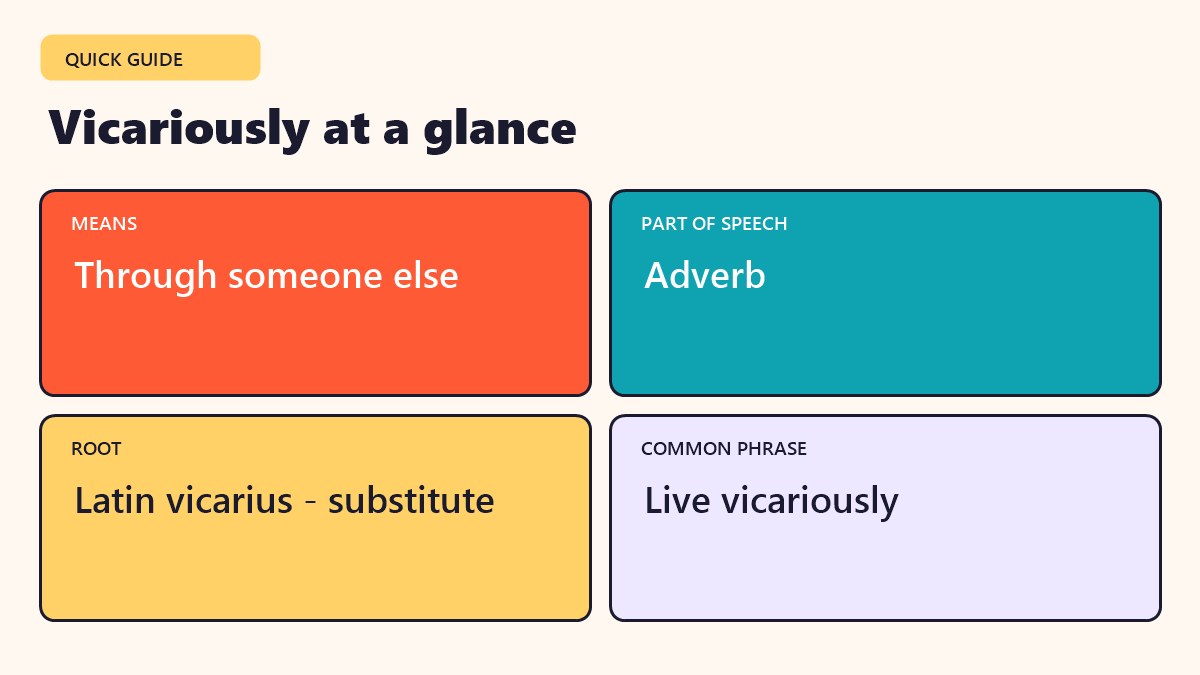
Vicariously is an adverb that means “experienced through another person.” It describes feeling or enjoying something because someone else is doing it, not because you are doing it yourself. The adjective is vicarious: “a vicarious thrill.”
The idea is very human. Humans are social, so we naturally share in the joy, fear and excitement of people we care about.
Where does vicariously come from?
The word comes from the Latin vicarius, which means “substitute” or “deputy.” The same root gave us the word vicar, a church official who acts in place of a higher one. A vicarious experience, then, is one in which another person acts in your place, and you feel the effect.
How to use vicariously in a sentence
- “She lived vicariously through her sister’s travels.”
- “I enjoyed the race vicariously by watching my friend run.”
- “He experienced the adventure vicariously through the documentary.”
- “Parents often feel proud vicariously when their children succeed.”
The pattern is usually “live vicariously through someone” or “experience something vicariously.”
Vicarious experiences in daily life
| Situation | Vicarious feeling |
|---|---|
| Watching a travel video | You feel the excitement of the trip |
| Cheering for a team | You feel joy or pain as if you played |
| Reading a thrilling novel | You feel fear and hope with the character |
| Hearing a friend’s good news | You feel proud and happy |
| Seeing someone embarrassed | You cringe, even if it is not you |
Notice that none of these are bad. They show empathy, which is one of our most useful social skills.
Vicarious learning
The idea also appears in psychology. Researcher Albert Bandura described how people learn by watching others, not only by acting themselves. If you see a coworker try a new method and fail, you learn what not to do without making that mistake. This is called vicarious learning or observational learning. It is a big reason why role models and videos are so helpful.
Vicarious in other fields
- Vicarious liability (law): a person or company can be responsible for the actions of another, such as an employer for an employee’s actions at work.
- Vicarious embarrassment: the cringe you feel for someone else’s awkward moment.
- Vicarious trauma: stress felt by people who care for or listen to those who have been through difficult events.
These uses share the same idea: something happens to one person, and another feels or is held responsible for it.
When vicarious living is healthy, and when it is not
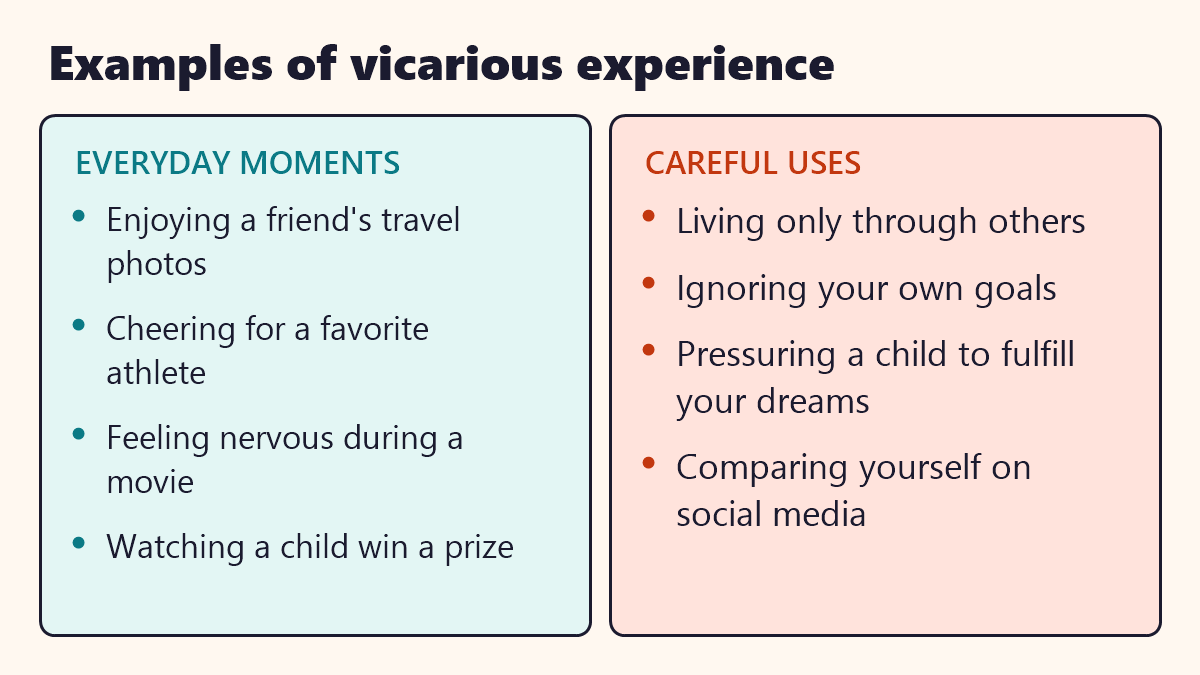
A little vicarious joy is wonderful. A problem appears when people stop chasing their own goals because they only watch others. A parent who says “I never got to play, so you must win” may put heavy pressure on a child. In the same way, spending hours watching other people’s perfect lives online can leave you feeling worse about your own.
Tips for a healthy balance
- Enjoy other people’s success, then ask what small step you could take yourself.
- Turn inspiration into action, such as booking one trip or trying one new hobby.
- Set boundaries with social media, so comparisons do not take over.
- Let children choose their own dreams.
- Share your own stories as well as cheering for others.
Common mistakes
- Using “vicariously” for direct experience. If you did it, it is not vicarious.
- Confusing it with “various.” They look similar but mean different things.
- Spelling it “vicariuosly.” The correct spelling is v-i-c-a-r-i-o-u-s-l-y.
- Using it for anything that is indirect. It needs another person’s experience.
Key takeaways
- Vicariously means experiencing something through another person.
- It comes from Latin vicarius, meaning “substitute.”
- Phrases like “live vicariously through” are common.
- Vicarious learning means learning by watching others.
- Enjoying others’ joy is healthy, as long as you still pursue your own goals.
Frequently asked questions
What does vicariously mean?
Vicariously means feeling or experiencing something through someone else’s actions or emotions.
What does it mean to live vicariously through someone?
It means enjoying that person’s experiences as if they were your own, often because you cannot or do not have the same chance.
Is living vicariously bad?
Not always. Enjoying others’ joy is normal. It becomes a problem when it replaces your own goals or puts pressure on the other person.
What is vicarious embarrassment?
It is the cringe you feel when someone else is embarrassed, sometimes called secondhand embarrassment.
Where does vicariously come from?
It comes from the Latin word vicarius, meaning “substitute,” the same root as “vicar.”