
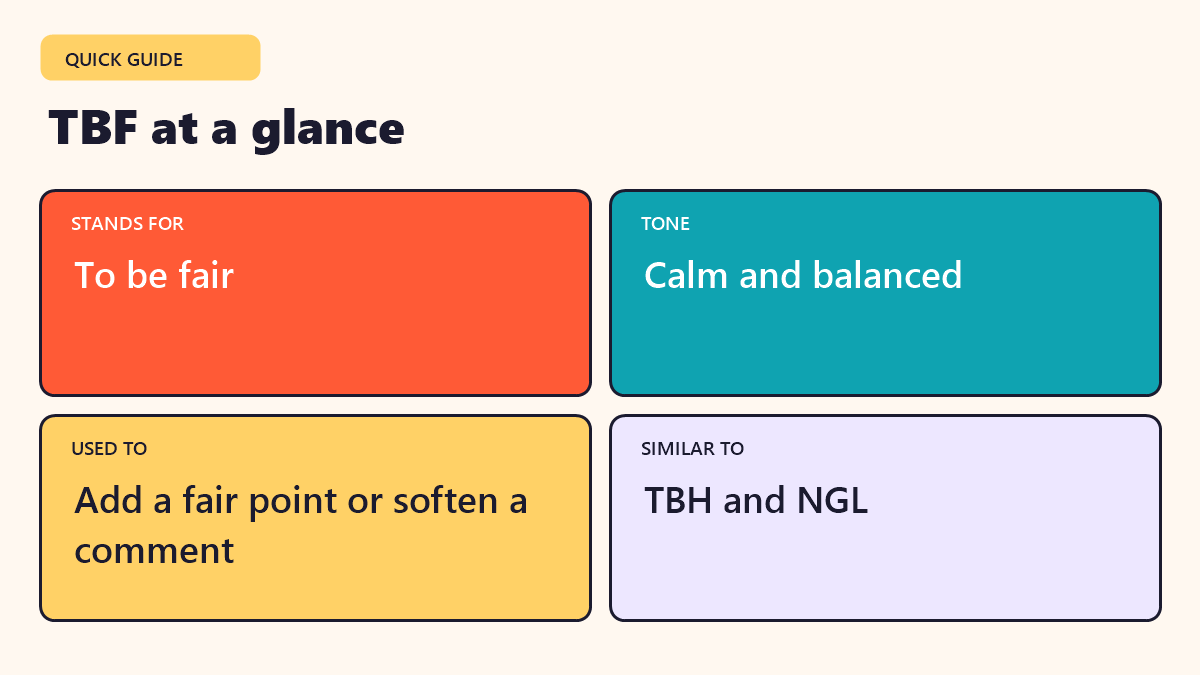
Quick answer: TBF stands for “to be fair.” People use it to add a fair point, give someone credit or soften a complaint. It is a calm, everyday phrase that works in texts, chats and even casual emails.
Featured image: Photo by Mohammad Mardani on Unsplash
A friend sends you “tbf, he did warn us,” and you realize you do not know the exact meaning. Do not worry. TBF is one of the gentlest abbreviations in everyday chat, and once you know the idea, you will start to see it in almost every group conversation.
In this guide
What does TBF mean?
TBF stands for “to be fair.” People use it right before a point that makes a statement more balanced. It says, “I want to be fair here,” and then adds a detail that might otherwise be left out.
Compare these two messages:
Message 1: The restaurant was slow.
Message 2: The restaurant was slow, tbf it was a Saturday night.
The second message sounds kinder and more complete. TBF gives context, so the person you are talking to knows you are not simply complaining.
Where does TBF come from?
The phrase “to be fair” is much older than texting. It has long been a favorite in British and Irish speech, where it often appears at the start or end of a sentence, as in “He was late, to be fair, but he did call.” Text messaging shortened it to TBF, and social media carried the short form across the world.
How people use TBF
To give someone credit
Friend: That movie was overhyped.
You: Tbf, the acting was great.
To soften a complaint
Friend: My brother forgot my birthday.
You: That hurts. Tbf, he has been super busy with work.
To admit the other side has a point
Friend: You always pick the music.
You: Tbf, you never say what you want to play.
In each example TBF does the same job: it adds the missing piece of the picture.
TBF vs TBH vs NGL vs ICL
Four short phrases are often mixed up. Here is how they differ.
| Abbreviation | Meaning | What it signals |
|---|---|---|
| TBF | To be fair | A balanced or kind point |
| TBH | To be honest | A frank opinion |
| NGL | Not gonna lie | A blunt or surprising truth |
| ICL | I can not lie | An honest confession |
Use TBF when you want to be fair, and TBH, NGL or ICL when you want to be direct. They can even work together: “TBH, it was good, tbf the price was great too.”
When TBF helps, and when it does not
TBF is mostly a friendly tool, but it can be misused. The graphic below shows quick examples.
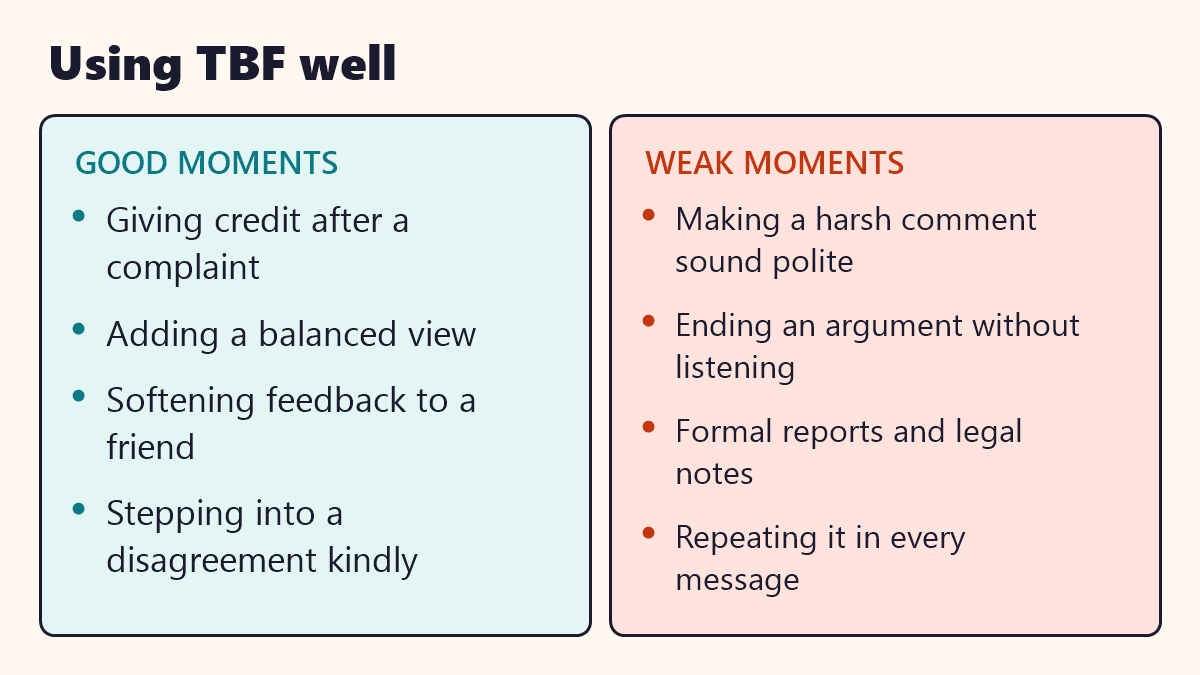
A small trap: some people use TBF to excuse unkind behavior. If your point is mean, adding “tbf” does not make it nice. Say what you mean, and be fair for real.
How to reply to TBF
- Agree: “True, that is fair.”
- Add more: “Yes, and they also had no time to prepare.”
- Disagree kindly: “I see that, but I still think it was too slow.”
- Keep it light: “Okay, okay, tbf to you too.”
Tips for using TBF naturally
- Use it once in a message, not every line.
- Put it where it adds new information, not just filler.
- Match your tone to the person. With friends, lowercase “tbf” is fine.
- In school and work writing, spell out “to be fair.”
- If you are upset, say so plainly instead of hiding behind “tbf.”
Real-life examples of TBF in group chats
TBF shows up most in conversations where people share opinions about shared experiences. Here are a few that will sound familiar.
Friend: The bus was so late today.
You: Tbf, it was raining hard.
Sister: Mom never listens to my music.
You: Tbf, you play it really loud.
Teammate: The coach was harsh today.
You: Tbf, we did lose by ten points.
In each case TBF gently brings in the other side. It prevents a chat from turning into a pile-on and helps the group stay kind.
Why “to be fair” is a useful habit
Beyond slang, the idea behind TBF is useful. When we are upset, we tend to see only the parts of a story that match our feelings. Adding one fair point does three good things. It shows you have listened, it lowers the heat and it often leads to a better answer. Many people find that a quick “tbf” in their own head also helps them calm down before sending a hasty message.
Common mistakes with TBF
- Using it as an excuse. “Tbf, I only yelled a little” does not make shouting okay.
- Ignoring the real problem. A fair point should add to the conversation, not end it.
- Overusing it. If every message has “tbf,” it loses its meaning.
- Sending it alone. A lone “tbf” without a point can confuse people.
Key takeaways
- TBF means “to be fair.”
- It adds balance, context or credit to a statement.
- It is different from TBH, NGL and ICL, which signal honesty or bluntness.
- It is friendly, but it will not turn a rude comment into a kind one.
- Spell it out in formal writing.
Frequently asked questions
What does TBF mean in text?
TBF means “to be fair.” It adds a fair or balanced point to a conversation.
Is TBF the same as TBH?
No. TBH means “to be honest” and introduces a frank opinion. TBF introduces a fair point, often in favor of someone or something.
Is TBF polite?
Yes, usually. It helps you sound balanced and thoughtful, but a harsh message is still harsh even with TBF in front of it.
Can I use TBF in an email?
In a casual email to someone you know well, it is fine. In formal work or school writing, write “to be fair” in full.
Is TBF British slang?
The phrase “to be fair” is very common in British and Irish English, but people use it everywhere now.