
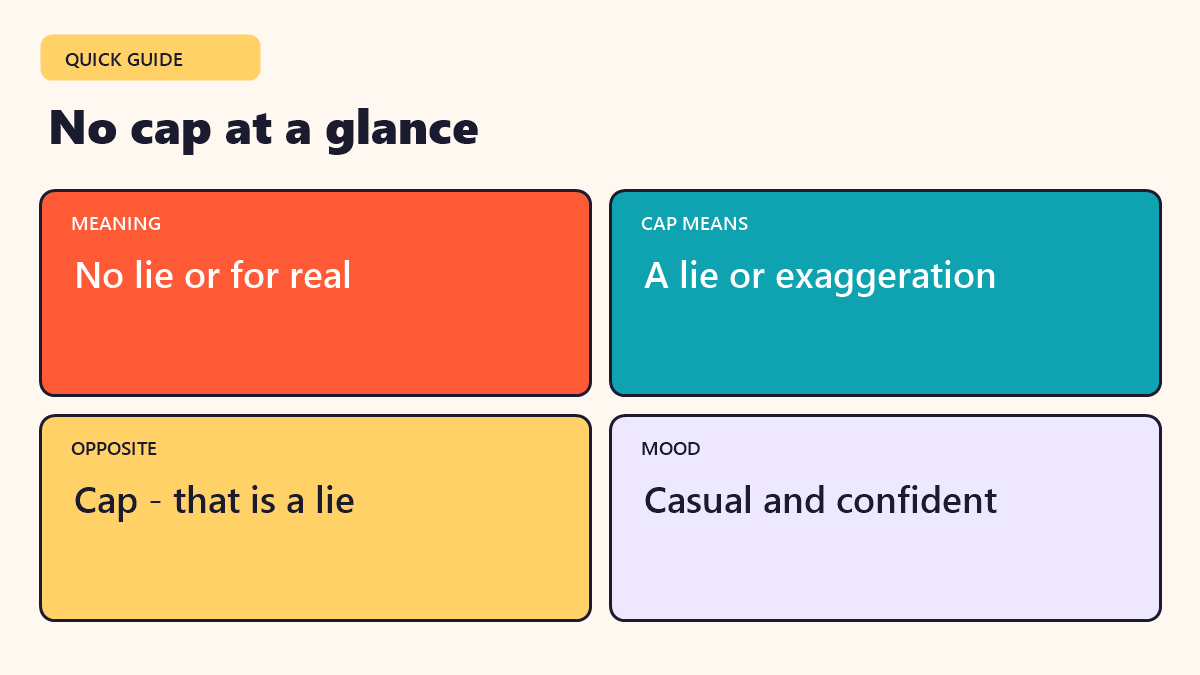
Quick answer: No cap means “no lie” or “I am being honest.” In slang, “cap” means a lie or an exaggeration, so saying “no cap” is like saying “I am not lying” or “for real.”
Featured image: Photo by Omar Lopez on Unsplash
A friend tells you, “That was the best pizza I have ever had, no cap.” You get the idea that the pizza was good, but what is the “cap”? This guide explains the word, the phrase and how to use them without sounding like you are trying too hard.
In this guide
- What does no cap mean?
- What does “cap” by itself mean?
- Where does no cap come from?
- How people use no cap
- No cap and its cousins
- How to use no cap well
- How to reply when someone says no cap
- Quick practice: cap or no cap?
- Why “truth” phrases are so popular
- Is it okay to use no cap with older people?
- Common mistakes with no cap
- Tips for sounding natural
- Key takeaways
What does no cap mean?
In slang, “cap” means a lie or an exaggeration. So “no cap” means “no lie.” It is a short way to tell someone, “I am being honest,” or “I really mean this.”
You might hear it after a big claim, like “I ran five miles today, no cap.” It is a friendly way to add weight to what you say.
What does “cap” by itself mean?
People also use “cap” alone. If a friend says, “I got a perfect score on the test,” and you doubt it, you might reply, “Cap.” That means “I do not believe you.” It is a quick and playful way to call out a stretch of the truth.
Friend: I can run faster than anyone in our class.
You: Cap.
Friend: Okay, almost anyone.
The related word “capping” describes the act of lying, as in “Stop capping, I saw you take it.”
Where does no cap come from?
The word “cap” in this sense has roots in African American English and hip-hop. People say it has been used for many years in spoken slang, and it reached a worldwide audience through music and social media in the late 2010s. Today it is common in group chats, videos and games, among many age groups.
How people use no cap
To back up an opinion
Friend: Is that new game any good?
You: It is the best one this year, no cap.
To show you are serious
Friend: Are you really moving to another city?
You: Yes, no cap. I signed the lease.
To call out a stretch
Friend: I never get tired.
You: That is cap, you slept through lunch.
No cap and its cousins
| Phrase | Meaning | Feeling |
|---|---|---|
| No cap | No lie | Casual and sure |
| Cap | A lie | Doubt or teasing |
| For real | Truly | Neutral |
| Deadass | Seriously | Strong, direct |
| On God | I swear | Very strong |
Choose the phrase that matches your friends and your style. No cap is milder than “on God,” and it fits almost any casual chat.
How to use no cap well
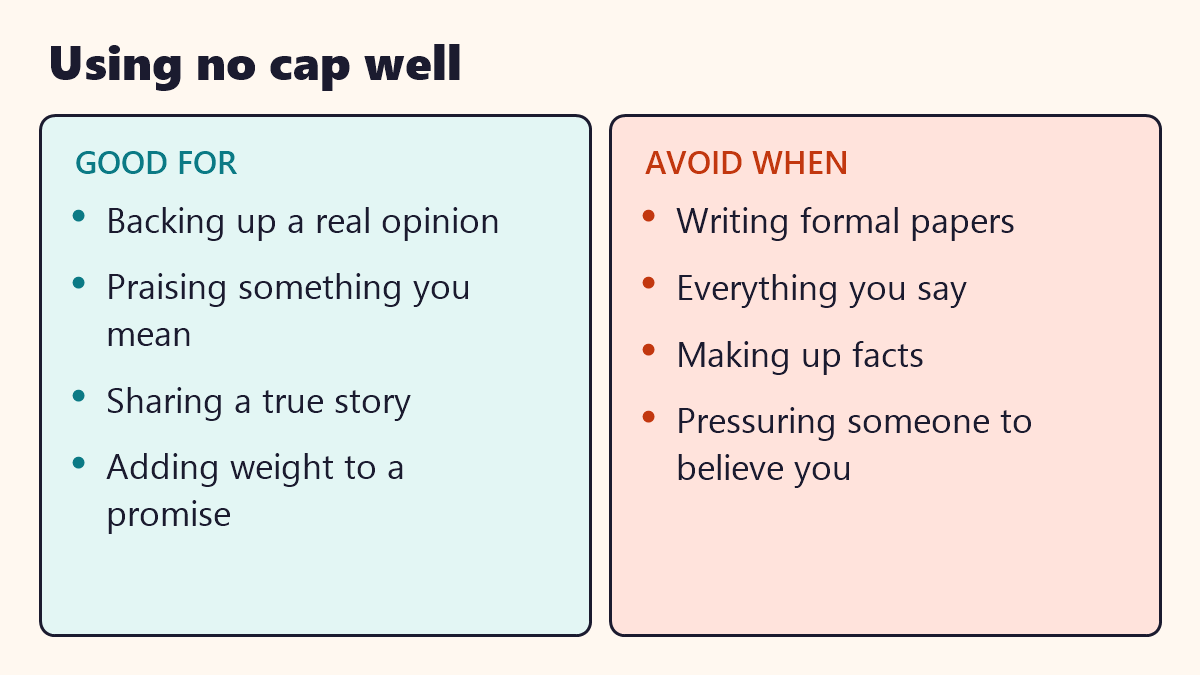
A good rule is to use “no cap” when the truth is worth emphasis. If you use it on every sentence, it loses its power, just like shouting all day makes people stop listening.
How to reply when someone says no cap
- When you believe them: “Wow, really? Nice.”
- When you are unsure: “For real?”
- When you doubt them: “Hmm, sounds like cap.”
- When you want to joke: “No cap, or a little cap?”
Quick practice: cap or no cap?
| Statement | Cap or no cap? | Why |
|---|---|---|
| “I finished the whole book in one hour.” | Probably cap | It is a very big claim |
| “The pasta here is really good, no cap.” | No cap | A normal opinion |
| “I have a million followers.” | Cap | Easy to check, and not true |
| “I woke up early today, no cap.” | No cap | A simple, believable statement |
Try this game with friends. Each person shares a statement, and the others guess “cap” or “no cap.” It is a fun way to practice and a good way to learn how the phrase feels.
Why “truth” phrases are so popular
Slang phrases like no cap, for real and on God show up whenever people want to sound sincere in short messages. Online, we cannot see each other’s faces, so we add small signals to say “I mean it.” These phrases also add personality. Saying “no cap” sounds more relaxed and more like a friend than “I am telling the truth.”
Is it okay to use no cap with older people?
Most people understand it by now, but the best approach is to match your audience. With friends and classmates, it is natural. With a grandparent or a boss, a simple “honestly” or “truly” may sound clearer. If someone asks what it means, a short explanation, “It means no lie,” is friendly and easy.
Common mistakes with no cap
- Using it for obvious facts. “The sun is bright, no cap” sounds odd.
- Using it to pressure. Saying “no cap” does not make a claim true.
- Using it in formal writing. It belongs in casual talk.
- Calling everything cap. People will think you do not trust anyone.
Tips for sounding natural
- Put “no cap” at the end of a claim, not in the middle.
- Use it when you really mean the statement.
- Keep your tone friendly when calling something “cap.”
- Use it with people who know the slang.
- If someone looks confused, explain it with a smile.
Key takeaways
- “Cap” means a lie or exaggeration.
- “No cap” means “no lie” or “for real.”
- It comes from African American English and hip-hop.
- Use it lightly, and keep your tone kind.
- Skip it in formal writing.
Frequently asked questions
What does no cap mean?
No cap means “no lie.” It tells the listener that you are being honest or serious.
What does cap mean?
In slang, “cap” means a lie or exaggeration. If someone says “that is cap,” they think it is not true.
What does “capping” mean?
Capping means lying or exaggerating. “Stop capping” means “stop lying.”
Where does no cap come from?
The slang has roots in African American English and hip-hop, and spread widely online in the late 2010s.
Is no cap rude?
No. It is casual, though calling someone’s claim “cap” can sound blunt, so use a friendly tone.